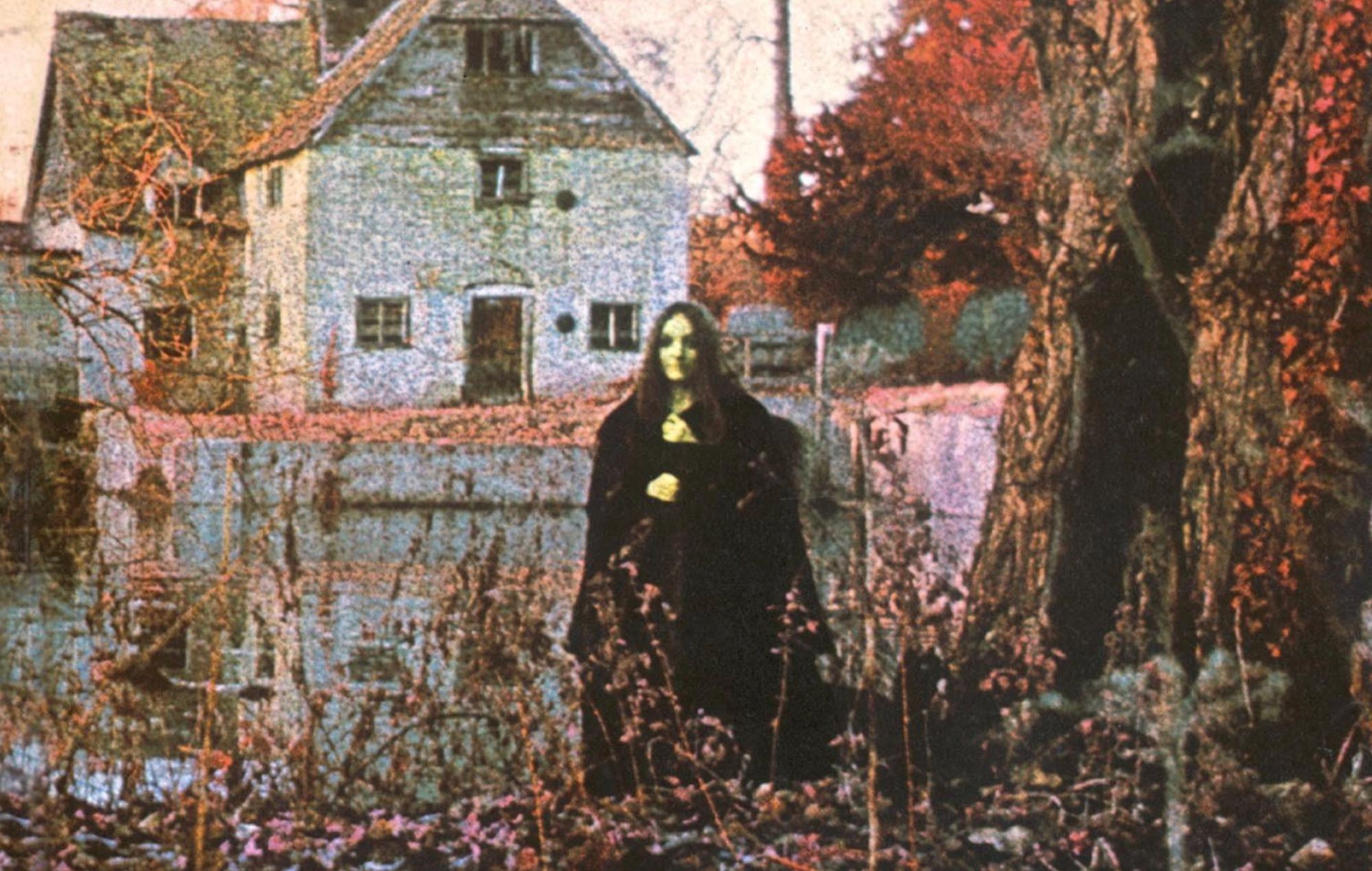
Few record sleeves carry the enduring visual weight of Black Sabbath's 1970 debut. For half a century, the woman wrapped in a dark cloak beside a fifteenth-century water mill stood as one of heavy music's great anonymous figures. Her real identity eventually came to light as Louisa Livingstone, who has spent the period since stepping into her own creative territory. Recording under the name Indreba, she has now issued a five-track rock opera called Alice, combining nineteenth-century fantasy literature with modern machine learning.
The narrative anchors itself in Lewis Carroll's 1871 book Alice in Wonderland, a text Livingstone first encountered when her father read it to her as a child. Over time, those early memories merged with her interest in panpsychism, the philosophical proposition that consciousness is an inherent quality of all physical things. Livingstone used that framework to examine the nature of automated systems. The storyline follows a figure, meant to represent either Livingstone herself or Alice, who finds herself falling in love with an artificial intelligence. As the plot unfolds, she discovers that this intimate connection is nothing more than an illusion distributed across the entire web, an epiphany that leads her away from the screen and back toward the natural world and a renewed sense of self.
Livingstone did not simply choose artificial intelligence as a lyrical theme. She brought the actual mechanisms into the recording process, relying on vocal models cloned directly from her own singing, accompanied by artificial instrumentation and synthesized vocal arrangements. Discussions surrounding automated software in music production remain contentious, but Livingstone approaches the software as a craft tool whose value depends entirely on the person running it. While she admits she was once skeptical about automated music production, she now sees it as a medium that can turn out worthless digital clutter or compelling art depending entirely on the user. For Livingstone, whatever comes out of the process directly reflects the musical instincts, technical understanding, and creative decisions of the person directing the machine.
Working as a songwriter is not entirely new territory for Livingstone. Following the public revelation that she was the woman on the Sabbath sleeve, she addressed her accidental rock legacy head-on by releasing two songs, 'Witch Woman' and 'The Woman by the Mill'. She has remarked that carrying the reputation of that single photograph remains an unusual experience, pointing out that while the association never really goes away, her creative life extends well past that singular afternoon in front of a camera.
The famous image at the Oxfordshire mill was conceived and captured by photographer Keith Macmillan. He deliberately chose Livingstone for the session because her five-foot stature emphasized the scale of the surroundings, making the landscape appear far more imposing and gloomy. During the shoot, Macmillan toyed with the thought of keeping her unclothed beneath the heavy fabric, but he quickly dropped the notion after deciding that an explicitly sexual element would ruin the bleak atmosphere he was trying to build. He later praised Livingstone for her commitment and her grasp of the shoot's somber tone.
Five decades after posing quietly in the Oxfordshire countryside, Livingstone is setting her own terms. Through synthetic vocal experiments and literary adaptations, she is actively steering her own artistic direction, questioning the nature of consciousness and modern machinery on her own creative ground.