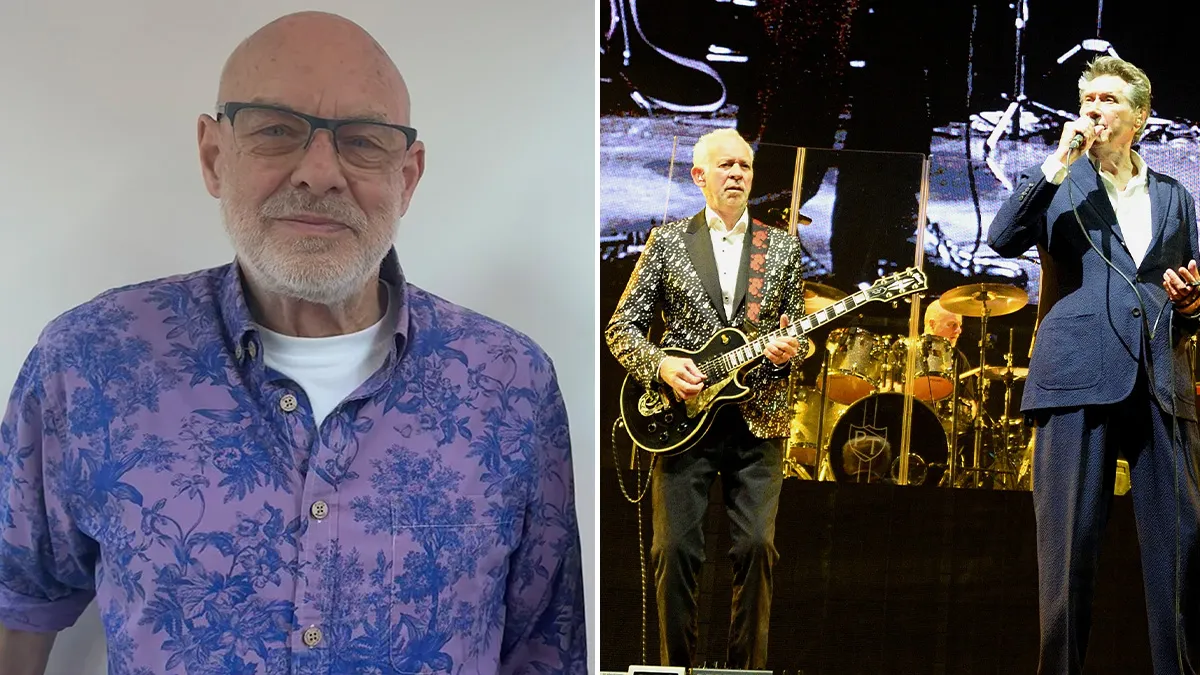
Nearly fifty years ago, Brian Eno released Music for Airports, transforming the sterile waiting halls of global transit into rooms for quiet contemplation and helping establish modern ambient sound. In the decades since, the composer and producer has taken his connection to aviation to an unexpected conclusion. Eno no longer travels through airports at all. According to his former bandmate Phil Manzanera, that strict personal rule recently kept Eno from participating in a major chapter of his own musical history.
The opportunity arrived when Roxy Music put together their 2022 tour, a run of shows conceived as a band reunion, a celebration of their fiftieth anniversary, and an official farewell itinerary. Milestone tours on that scale rarely happen twice, and when a group reaches five decades, the urge to assemble the original personnel for a final curtain call is substantial. Manzanera explained that Eno was invited to join his former bandmates for the tour, but the offer was turned down.
His refusal did not stem from creative friction, scheduling conflicts, or studio work. Instead, Eno stepped aside purely on principle, maintaining a personal stand against air travel for environmental reasons. For Eno, that ecological commitment took precedence over nostalgia, even when presented with an occasion of this magnitude.
For listeners who had followed Roxy Music from their beginnings in the early 1970s, seeing Eno back on stage with the group would have offered a profound sense of closure. During his time with the band, Eno helped forge their adventurous identity, introducing electronic experimentation and unconventional textures into the format of art rock. Those contributions helped define what made the group distinct. Yet when the moment came to celebrate fifty years of that shared legacy, nostalgia was not enough to override his environmental stance.
The situation also illustrates the steep logistical hurdles of staging concert tours at the arena level. Taking a show through multiple cities demands moving personnel, equipment, and stage production rapidly across great distances. Modern concert promotion is organised almost exclusively around commercial aviation and private planes to keep those complex itineraries on schedule. Without air transit, an artist cannot realistically participate in an international tour unless the production adopts radical, slow travel alternatives. Large scale farewell productions simply do not accommodate adjustments of that kind. By ruling out planes, an artist effectively steps away from the traditional touring circuit.
It is rare to see a musician decline a lucrative, legacy defining appearance strictly on principle. Eno passing on Roxy Music's final run makes it clear that his environmental convictions are far more than theoretical talk. Fans never got to witness that final onstage reunion to mark fifty years of the band, but Eno's absence from the tour delivered its own quiet message about the cost of keeping modern concert machinery aloft.