Kim Gordon has spent more than forty years dismantling how rock bands use electric guitars, but she still hesitates to call herself a musician. Her background belongs to visual art, and that perspective shaped everything she did across three decades in Sonic Youth and through her ongoing solo projects. Instead of treating six strings as an academic exercise or a test of technical prowess, she has always handled instruments as physical objects intended for raw expression.
That relationship began entirely by accident in the early 1980s. Living in downtown Manhattan, Gordon entered the music scene through the local art community rather than the rehearsal room circuit. Her first guitar was essentially a piece of domestic debris, left behind by her roommate's former boyfriend after their breakup. Jeffrey Lohn of the no wave group Theoretical Girls offered her an initial, informal lesson, demonstrating how to fret partial jazz chords across just three or four strings. The instrument carried its own odd social history. When Gordon first crossed paths with Thurston Moore, he recognized the guitar immediately because he knew the previous owner. Moore eventually took it over for the Sonic Youth track Burning Spear, sliding a wooden drumstick beneath the strings and striking them with another to produce a rattling percussive clatter.
Her second instrument was just as unusual, an East German Eterna model picked up during a visit to Berlin. Gordon cannot pinpoint which early recordings featured that guitar, but seeking out strange body shapes and unpolished tones quickly became second nature. Her listening habits were already rooted in jazz and free jazz, so the abrasive, fractured energy of New York no wave felt familiar rather than alienating. Downtown composers such as Glenn Branca and Rhys Chatham were already organizing ensembles around walls of guitars tuned to custom pitches to summon ringing overtones. When Sonic Youth formed in 1981, Gordon handled guitar duties before moving over to bass simply because the musical parts she wrote naturally belonged in the lower register. She never took formal lessons, relying instead on her ear, her visual artist instincts, and the anti-corporate spirit of post-punk.
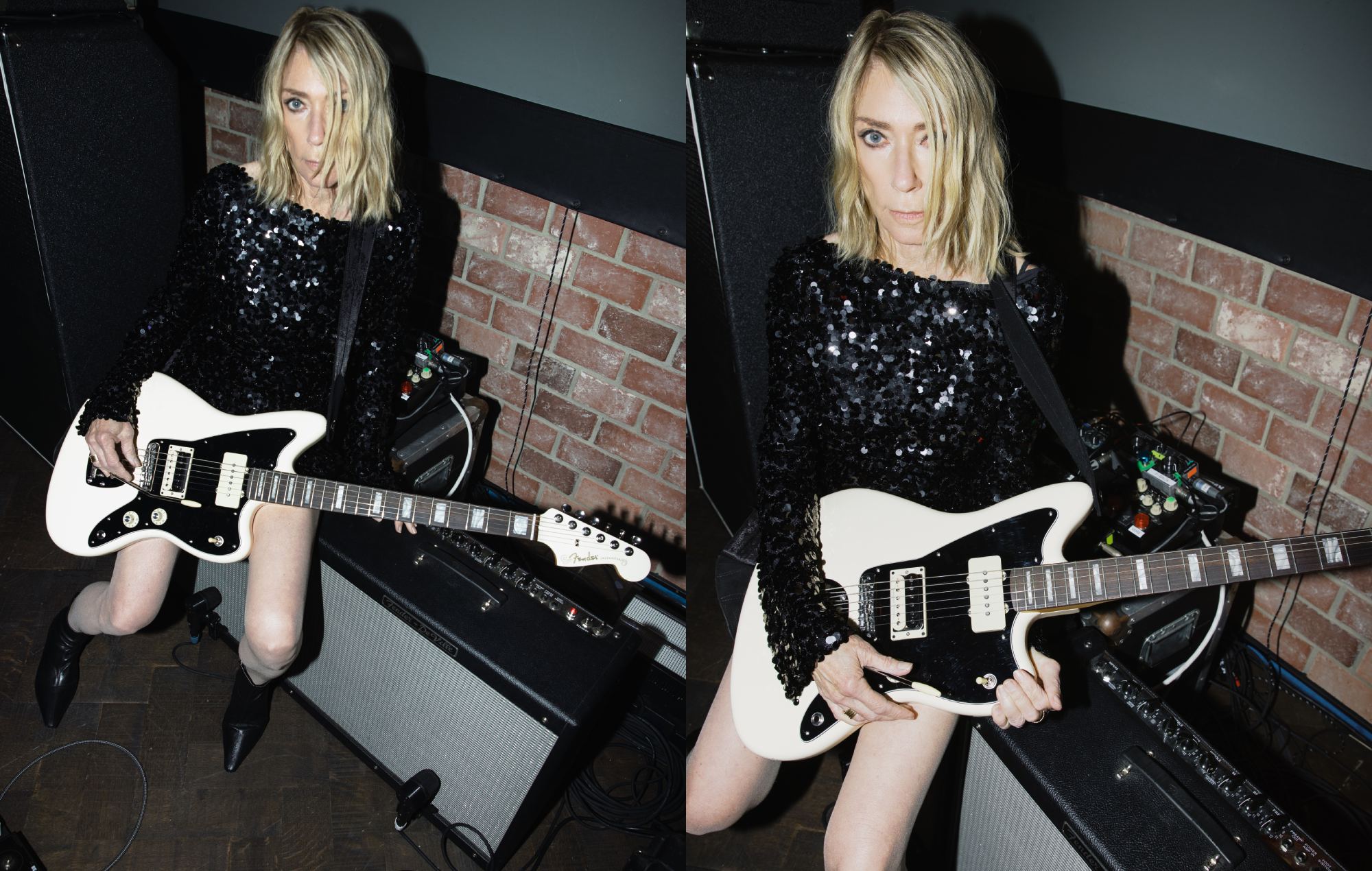
Now, decades after those initial downtown experiments, Gordon has partnered with Fender to introduce the Limited Edition Kim Gordon Jazzmaster. The model takes its cues from a 2008 Mexican Standard guitar handed to her on Sonic Youth's final tour across South America in 2011, shortly before the group separated following the end of her marriage to Moore. For this production run, the instrument carries an inverted colorway alongside several practical modifications suggested by her close friends and musical collaborators. In place of a standard electronics configuration, the bridge position features a humbucker while the neck retains a traditional Fender single-coil, balancing sharp, heavy output against the classic offset chime.
By placing her name on the headstock, Gordon steps into an established circle of idiosyncratic Jazzmaster players that includes Tom Verlaine of Television, Elvis Costello, J Mascis of Dinosaur Jr, Robert Smith of The Cure, and Kevin Shields of My Bloody Valentine. Unlike many of her peers in that company, Gordon has never measured her work by conventional standards of virtuosity. While her musical vocabulary has expanded over the years, her core creative approach remains firmly anchored to those early lofts.
What has transformed dramatically is the cultural reception of that sound. When Sonic Youth were developing their style in the 1980s, critics and casual listeners regularly threw the word noise around as an insult. Gordon and her bandmates considered those harsh tones to be shading and color, an honest way to depict the realities of their environment without smoothing over the cracks. Today, she notes, younger musicians treat dissonance as an ordinary working tool rather than a boundary waiting to be tested. The arrival of a signature guitar also lands at a peculiar point in her catalog. Her recent solo record, Play Me, largely sets heavy guitar feedback aside in favor of trip-hop textures and beat-driven arrangements. Stepping into fresh rhythmic territory while issuing a signature electric model highlights the restless instincts that have driven her work from the beginning.