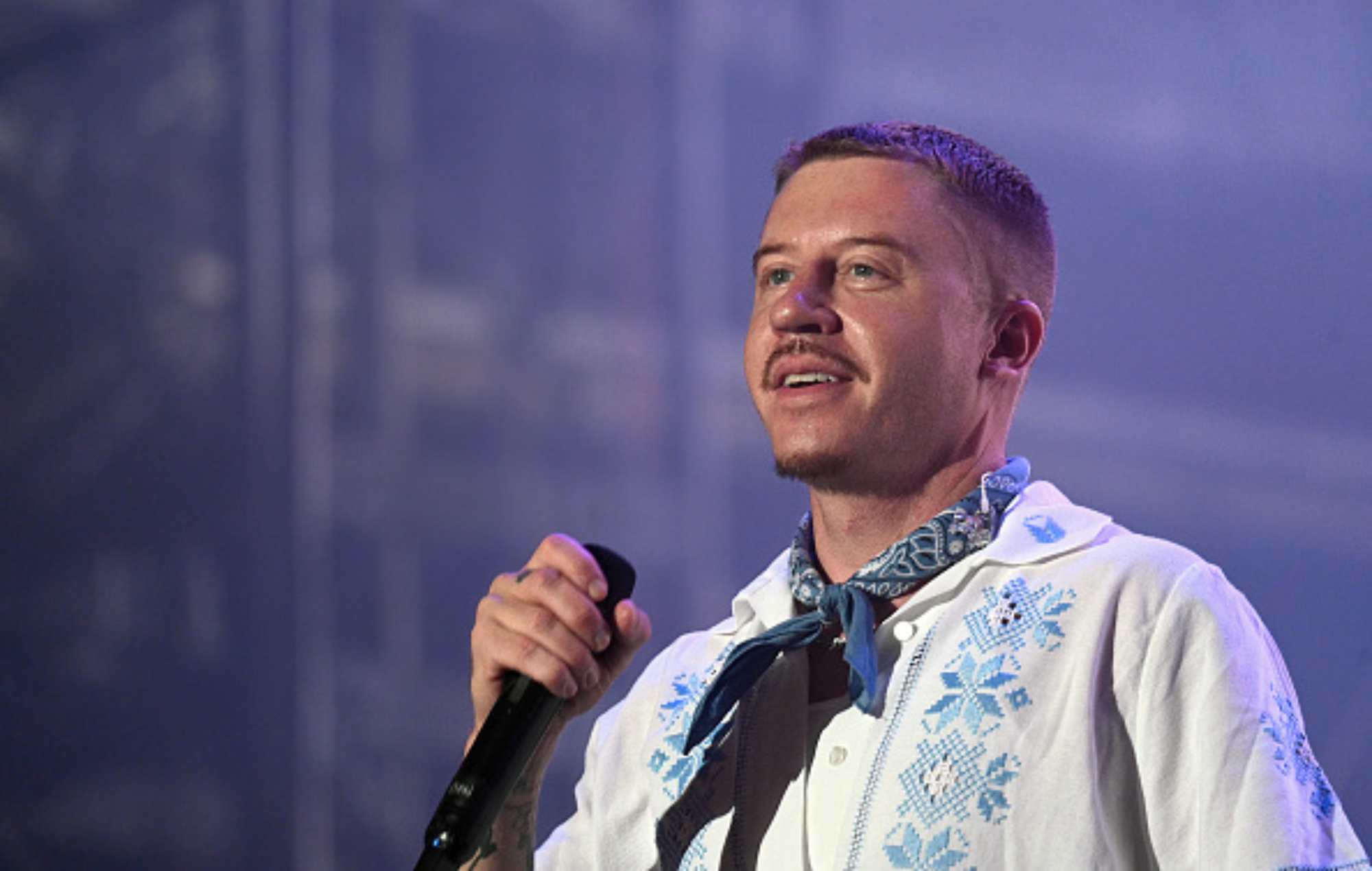
Macklemore's appearance at Red Rocks Amphitheatre on Thursday, October 22, was never going to be an ordinary stop. Taking the Colorado stage for a seventeen song set, the Seattle rapper gave his first public performance since being pulled from Ed Sheeran's North American stadium run. Rather than softening the rhetoric that had recently cost him an arena support slot, he spent the evening expanding on it, addressing several global humanitarian crises and challenging domestic immigration enforcement.
Addressing the Red Rocks crowd directly, Macklemore maintained that speaking up for human life ought to be neither complicated nor strictly political. He framed his stance around basic empathy, arguing that feeling compassion for those who are suffering is simply human. Alongside repeated calls for a free Palestine, he drew attention to ongoing civilian struggles across Sudan, Congo, Lebanon, and Haiti. Macklemore also shifted focus to United States domestic policy, voicing solidarity with immigrant communities living under the threat of Immigration and Customs Enforcement. The crowd responded with loud cheers before he reiterated that love sits at the heart of his message.
The dispute that brought him to this point originated at MetLife Stadium in New Jersey, where Macklemore had been opening dates on Sheeran's Loop tour. During that appearance, he delivered a speech calling for dignity, equality, and respect for all people, explicitly mentioning those living in Gaza and the West Bank. He paired the remarks with a performance of Hind's Hall, his 2024 protest track, while visuals from Gaza played across the stadium screens. The set provoked swift backlash from the Israeli-American Council and fellow artists such as Pink. Macklemore pushed back against the criticism, arguing that standing up for basic human equality should never be treated as something divisive or unacceptable.
Tensions peaked when Robert Kraft, owner of Gillette Stadium in Massachusetts, expressed objections to the rapper appearing on his premises during upcoming dates. Macklemore was subsequently removed from the tour. According to the rapper, Sheeran clarified that Kraft and several other venue operators had pushed back against his inclusion on the bill. The firing triggered an immediate, unexpected reaction within Sheeran's camp. Every other opening act on the lineup resigned in solidarity, and Sheeran's own backing band walked out as well. Macklemore redirected all of his earnings from the tour, amounting to one million dollars, across six different organizations providing aid to Palestinians, urging Kraft to reflect on the worth of civilian lives. Kraft later committed two million dollars toward humanitarian aid in the area.
The disruption took a heavy toll on Sheeran. When he returned to performing, the British singer made a public apology from the stage, admitting he handled the situation poorly and acknowledging that the turmoil had led him to wonder whether he even wanted to remain in the music industry. In an odd twist, the Gillette Stadium dates that prompted Macklemore's firing never happened anyway, cancelled at the last minute because of severe weather warnings. Meanwhile, support arrived from across the music community. Tom Morello publicly noted that courage tends to be contagious, while Lorde appeared wearing pro-Palestine clothing directed at Kraft.
Rather than retreating, Macklemore channeled the public attention into a short string of European and British benefit gigs under the Free Palestine banner. Tickets sold out almost instantly. Reflecting on how swiftly audiences mobilized, Macklemore remarked that community backing made the dates possible, underscoring that musicians carry the ability to create real impact from the stage. For him, whenever institutional powers attempt to suppress appeals for human freedom, artistic expression remains a vital form of resistance.