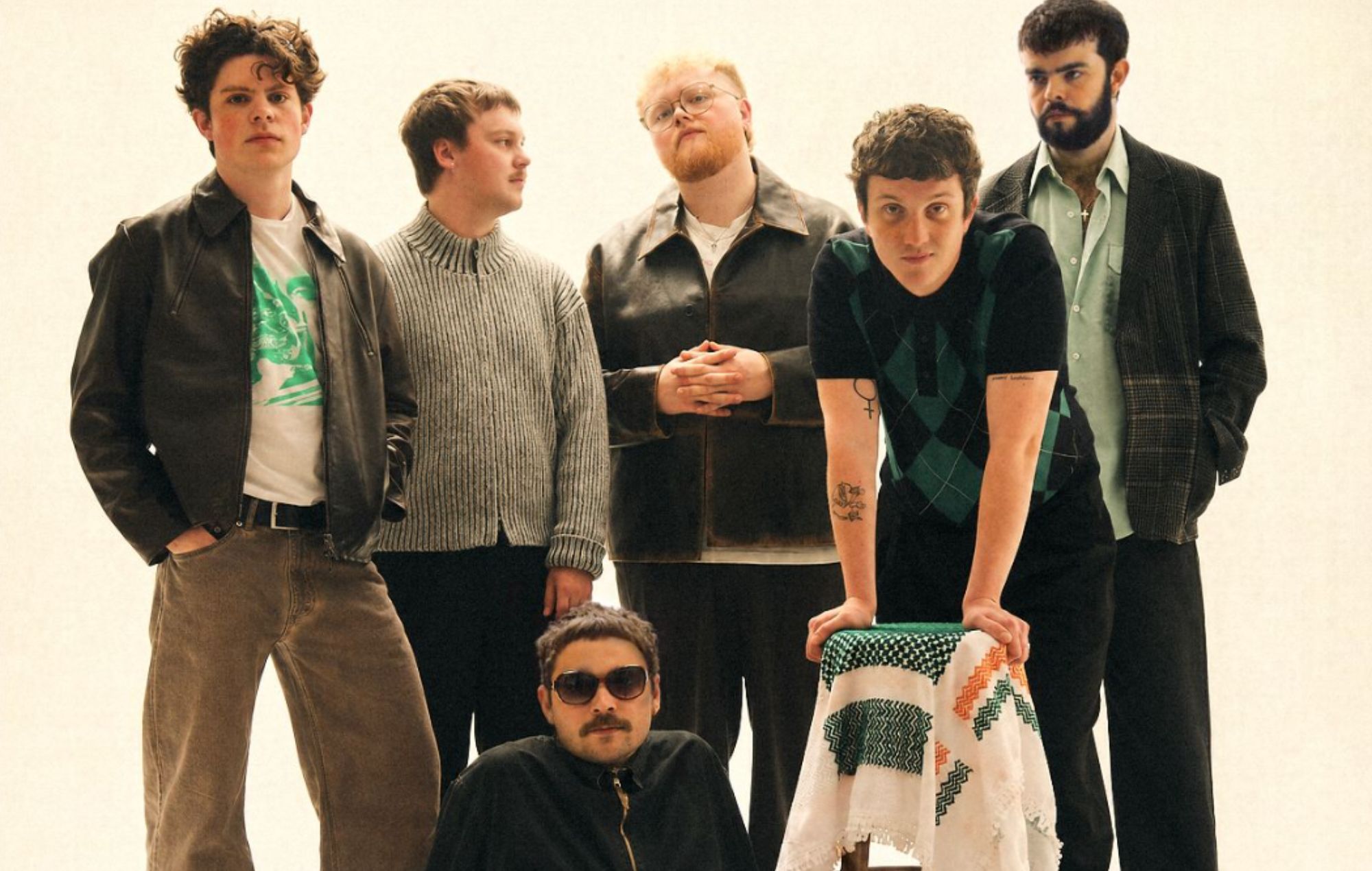
Dublin six-piece Madra Salach have spent the past year building a formidable reputation on the road. Following their initial EP, It's A Hell Of An Age, the band made a name for themselves through raw, high-friction updates to traditional folk forms. Now, they are ready to step forward with their first full-length effort. Titled Gorta, the album is scheduled to arrive on January 15 via Island Records, accompanied by the release of its lead single, Ribbon Factory.
To record the album, the band traveled across the Atlantic to New York to work alongside producer Loren Humphrey, whose recent resume includes work with Westside Cowboy and Cameron Winter. Uprooting an ensemble steeped in Irish traditions and placing them in an American studio was an intentional move to widen their sound. While the traditional core remains intact, the sessions with Humphrey pushed the six-piece into heavier, murkier, and more experimental territory than their previous material suggested.
That shift in weight is announced by the record's title. Gorta is the Irish word for hunger, a term freighted with historical trauma across the island. The group use the concept not as an abstract historical artifact, but as a lens to look at multiple forms of yearning. The songs explore what people leave behind when they move on, alongside the psychological inheritances passed down through families. For vocalist Paul Banks, the only sensible way to address such heavy communal history is to keep the focus sharply personal.
Banks deliberately stepped back from sweeping statements during the writing sessions. He noted that he avoids taking too broad or grand a vantage point in his lyrics, preferring to write directly from immediate, personal emotional states. Even so, he sees an undeniable connection between those private longings and the daily reality of modern Ireland. Ideas of hunger and longing seem to fit naturally into twenty-first-century Irish life, with Banks observing that the more he examines and writes about Irish identity, the more peculiar and distinct its historical position appears to him.
That uneasy mood runs directly through Ribbon Factory, an imposing track characterized by a stark, gothic atmosphere. The song will already be familiar to anyone who caught the group live over the past twelve months. Madra Salach wrote the track in early 2025 and kept it in constant rotation on stage throughout their tours. In a joint statement, the band described the song as a piece of writing that fundamentally redirected their trajectory, noting that finally delivering a completed studio version after a full year of live performances brings a genuine sense of arrival.
That trial-by-stage approach has shaped the entire record. Following high-profile live stops, including an appearance at The Great Escape festival earlier this year, the band watched their crowds steadily multiply. The growing scale came as a genuine surprise to Banks, who had initially mapped out a far more modest trajectory for the band. The frontman admitted that the wider commercial attention caught him completely off guard, having originally hoped only to maintain a quiet presence within Dublin's folk revival circles and play intimate rooms. Because so much of Gorta was drafted while navigating that demanding tour schedule, the songs were conceived specifically for live physical impact.
The visual framing of the record reflects the same fixation with strange history. Designed by Oscar Torrans, the cover art depicts a Blemmyes, a legendary creature from medieval myth that lacks a head, carrying its eyes and mouth directly on its chest. It provides an unsettling visual partner to an album preoccupied with historical dislocation, absence, and inherited memory.
By pulling the raw momentum of their live shows into Humphrey's studio, Madra Salach are positioning Gorta as a substantial, deliberate progression beyond the margins of the contemporary folk circuit.