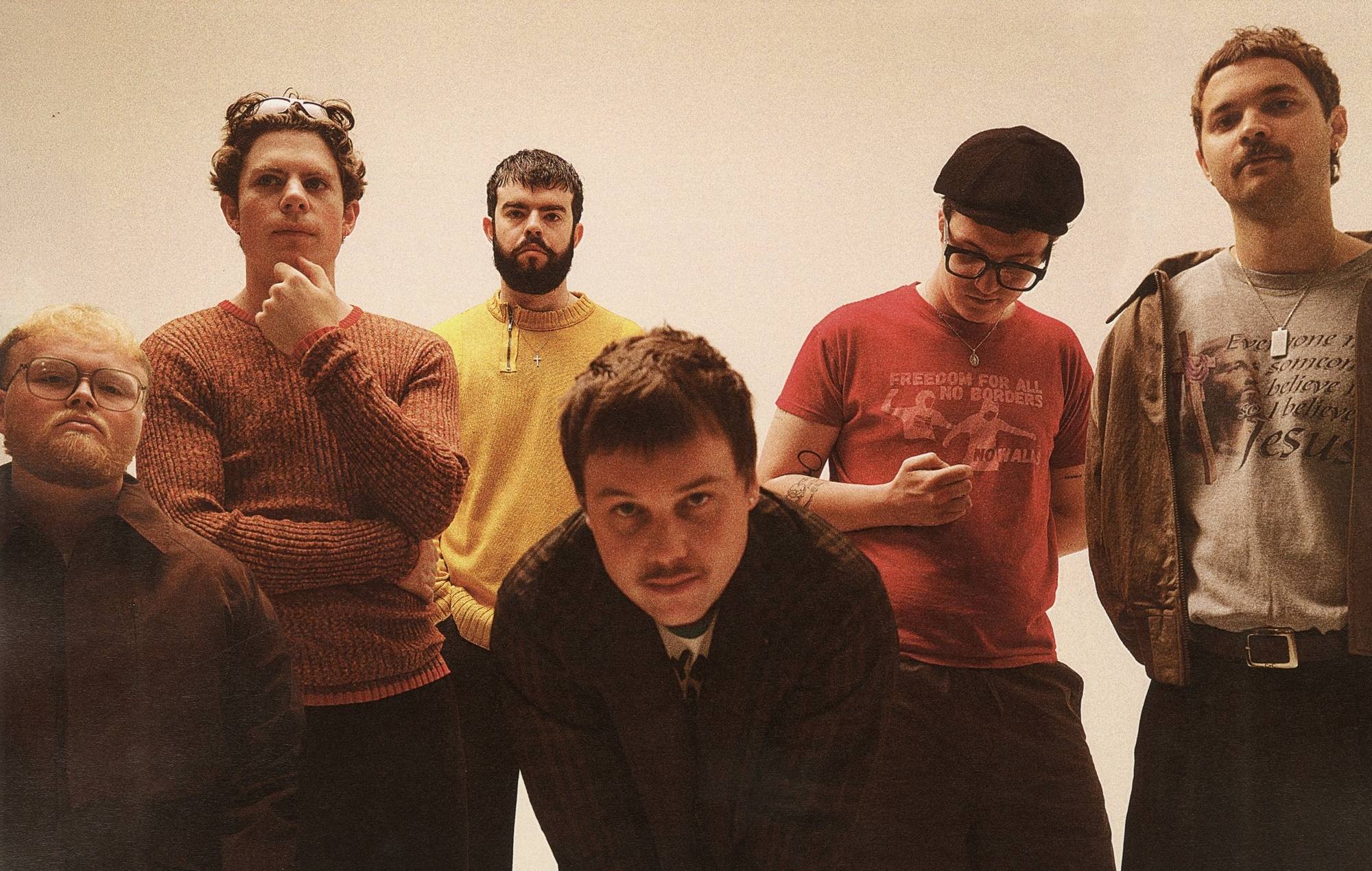
Madra Salach are not treating traditional Irish music as an antique to keep behind glass. Over the past twelve months, the Dublin six-piece have taken those older forms and dragged them through abrasive, experimental territory, arriving at something dense and distinctly raw. Their latest track, Searrach, gives listeners another preview of what that tension sounds like in practice ahead of their debut full-length record.
Arriving shortly after last month's single Ribbon Factory, Searrach shifts the focus inward. Frontman Paul Banks described the writing process as an immediate breakthrough for the group, pointing to the song as one of their proudest pieces of work on the upcoming record. Lyrically and thematically, it turns on ideas of change, deception, and personal compromise, putting a sharp point on self-betrayal. For Banks, getting this specific song right proved critical to unlocking the broader scope of their upcoming release.
That record, titled Gorta, is due out on January 15 through Island Records. Taking its name from the Irish word for hunger, the album serves as the direct successor to their first collection, the EP It’s A Hell Of An Age. To track the new material, the band decamped to New York to work with producer Loren Humphrey, whose previous credits include sessions with Westside Cowboy and Cameron Winter. In the studio, Humphrey helped the sextet keep their folk foundation intact while stretching their arrangements toward murkier, heavier textures.
The packaging around Gorta leans into similarly unsettling reference points. Designer Oscar Torrans created the cover illustration, which features a Blemmyes, the mythical headless figure from medieval lore whose face sits planted in the center of its chest. It is a strange, jarring visual choice, but one that fits the record's underlying fixations on displacement, deprivation, and reckoning.
This creative expansion arrives after an exhausting stretch of touring that upended the group's modest expectations. Talking around the time of their performance at The Great Escape festival earlier this year, Banks confessed that the wider public reaction came as a complete shock. When Madra Salach started out, the goal was merely to carve out a steady existence inside Dublin's traditional folk revival, occasionally packing out local back rooms. The audience, however, grew faster than anticipated, pulling the band toward much larger spaces.
Much of that draw comes down to how these arrangements function in front of a crowd. As Banks explained, the songs were constructed specifically for live performance, relying on volume, sweat, and collective forward motion. That physical emphasis has already pushed the six-piece from afternoon festival showcases to major headlining bills, including a recent appearance at London's Electric Ballroom. With Searrach now in circulation, Gorta is shaping up to be an uncompromising arrival when it lands in the middle of January.