When veteran acts team up for an amphitheater tour, audiences usually expect a predictable rotation of familiar hits, tidied up for outdoor acoustics and an early curfew. What happened on Tuesday, September 22nd, at the Hartford HealthCare Amphitheater in Bridgeport, Connecticut, broke away from that script. Neil Young kicked off the first night of a two-date co-headlining stand alongside Willie Nelson, bringing a degree of physical friction that few saw coming.
Co-headlining tours enforce a strict sense of discipline. When two heavyweight figures split the evening, nobody gets the luxury of a three-hour run through forgotten album cuts. Young kept his set to an economical twelve songs. Every track had to earn its spot, with no room left for leisurely pacing or polite, low-stakes filler. The brevity seemed to sharpen his focus, giving the entire appearance a direct, concentrated momentum.
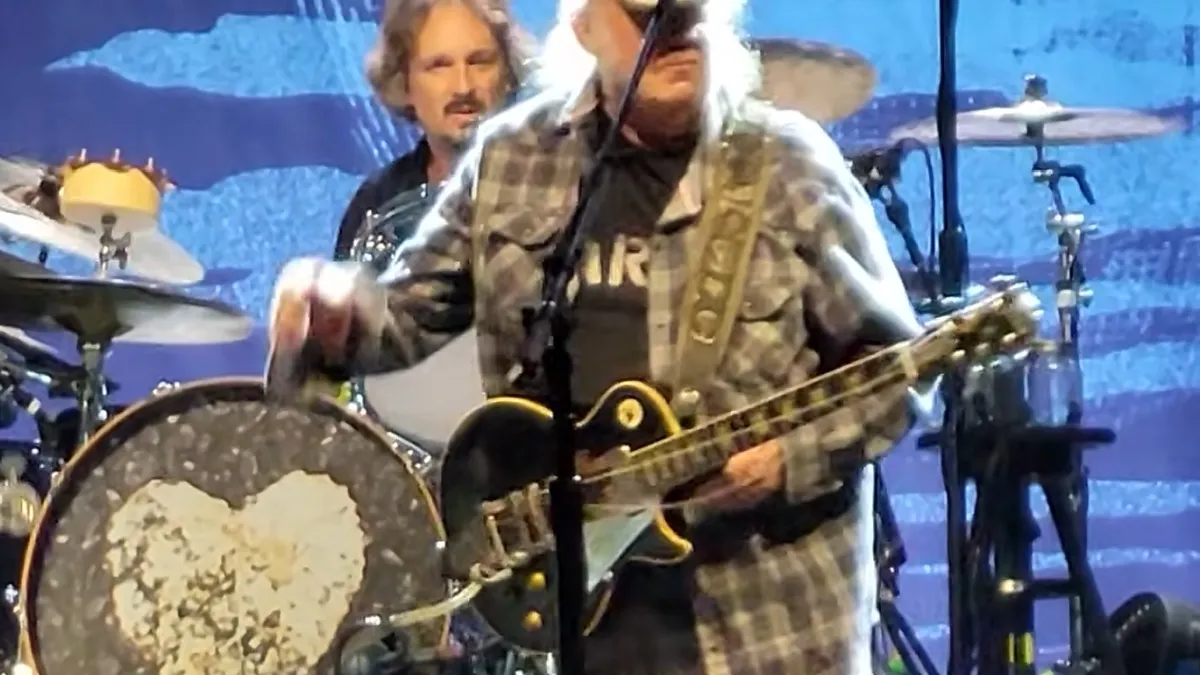
Whatever restraint dictated the setlist dissolved during the finale. Young, now 80 years old, closed the performance with "Rockin' in the Free World." The song has served as his regular stage anchor across decades, but in Bridgeport, it discarded all polish in favor of raw noise. As he pushed the track to its breaking point, Young literally tore strings off his guitar. In the middle of the racket, he shouted chants of "Take America Back!" into the venue, abandoning any pretense of an easy, nostalgic singalong.
Snapped strings usually count as a minor annoyance on stage, fixed in seconds when a guitar tech rushes out with fresh hardware. Tearing strings clean off an instrument under the pressure of a song is entirely different. It points to a player actively testing the structural tolerance of the wood and metal in his hands. That physical wreckage matched the volume, turning the anthem into a volatile statement rather than a comfortable, rehearsed routine.
Musicians who reach their eighth decade can easily coast on catalog affection, trading in decades of goodwill for polite applause. Young took the opposite route in Bridgeport. He leaned into distortion, feedback, and open confrontation, treating his instrument as an engine for sheer volume rather than a museum piece. The crowd was left with roaring amplifiers and vocal fury instead of an orderly, affectionate sign-off.
With night one concluded, the tone is established for the second installment of the Bridgeport run with Nelson. Co-headlining dates on summer amphitheater circuits rarely feature instruments reduced to scrap or artists testing physical limits with that sort of abandon. The opening performance left things frayed, noisy, and completely unsettled for whatever follows.