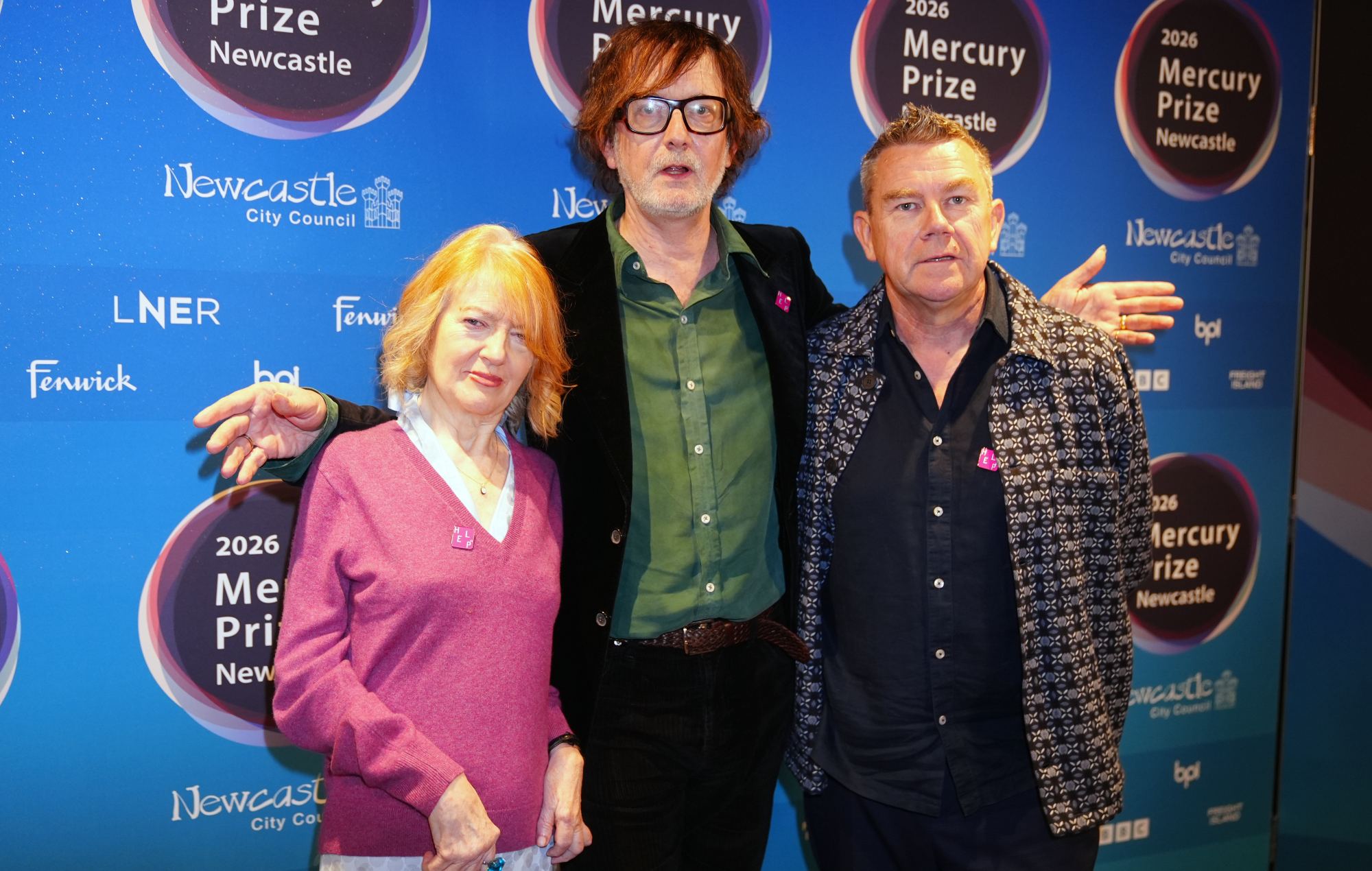
When Pulp took the stage in Newcastle on Thursday, October 22, they were not there simply to bask in their own history. Instead, the Sheffield group appeared at the Mercury Prize ceremony to play Begging For Change on behalf of Help(2), the War Child charity release shortlisted for the 2026 prize. Representing a sprawling compilation of more than twenty artists might seem an unusual assignment for a veteran band, but the appearance closed a loop that started thirty years earlier.
Back in 1996, Pulp won the Mercury Prize for Different Class. That victory came at the expense of the original Help album, which Brian Eno had put together the previous year to raise funds for War Child. Rather than pocketing the twenty-five thousand pounds that accompanied the trophy, Pulp handed the entire sum directly over to the charity. The transfer, however, proved considerably more precarious than anyone in the room understood at the time.
Keyboard player Candida Doyle had been tasked with passing the envelope containing the cheque to Eno, handing it over alongside the physical award. Eno took the items without realising what the slip of paper actually was, assuming the packet was nothing more than part of the packaging wrapped around the statuette. Only when speaking with Doyle later did Eno reveal that he had come extraordinarily close to throwing the envelope straight into the bin, completely unaware that a cheque for twenty-five thousand pounds was tucked inside. Doyle also remembered learning during that same conversation that Eno's father had been a postman, prompting Jarvis Cocker to joke that she has stayed on the phone with Eno every week ever since.
As for the rest of that night in 1996, the memories are mostly a blur. Cocker has admitted that heavy drinking wiped out almost any recollection he had of the celebrations. Drummer Nick Banks did manage to remember spraying champagne all over the room, an act Cocker cheerfully dismissed as standard operating procedure for a drummer.
Their relationship with the Help project had actually begun with injured pride a year before the win. In 1995, Eno had marshalled an extraordinary cast into Abbey Road Studios to record the original album in a single day. Paul McCartney, Radiohead, Oasis, Blur, Portishead, Massive Attack, Suede, Orbital, and Sinéad O'Connor all took part. Pulp, watching from the outside, were not invited. Cocker remembered feeling a sharp twinge of jealousy at being left off the roster while their peers cut tracks across the capital.
Help(2) finally squared that old account. The modern follow up collected an entirely new wave of musicians, placing Pulp alongside Arctic Monkeys, Fontaines D.C., Wet Leg, Young Fathers, English Teacher, Damon Albarn, Cameron Winter of Geese, and Olivia Rodrigo. Standing up for that company in Newcastle made sense to Cocker, who observed that he appreciates circles and considered it an honour to represent the record on stage.
As an exercise in record making, anthologies bring their own distinct hurdles. Reflecting on the mechanics of compilations, Doyle maintained that the success of any record comes down to solid songwriting. Banks took a broader view, pointing out that multi-artist collections face peculiar difficulties when contrasting genres and clashing musical ideas are forced to sit beside each other.
Pulp were no strangers to the Mercury podium, having been shortlisted the previous year for their comeback album More. Yet taking the stage to play Begging For Change in Newcastle was less about another award race and more about settling an old narrative. Three decades after an overlooked invitation, an accidental near miss with a rubbish bin, and a donated winner's purse, the story finally came full circle.