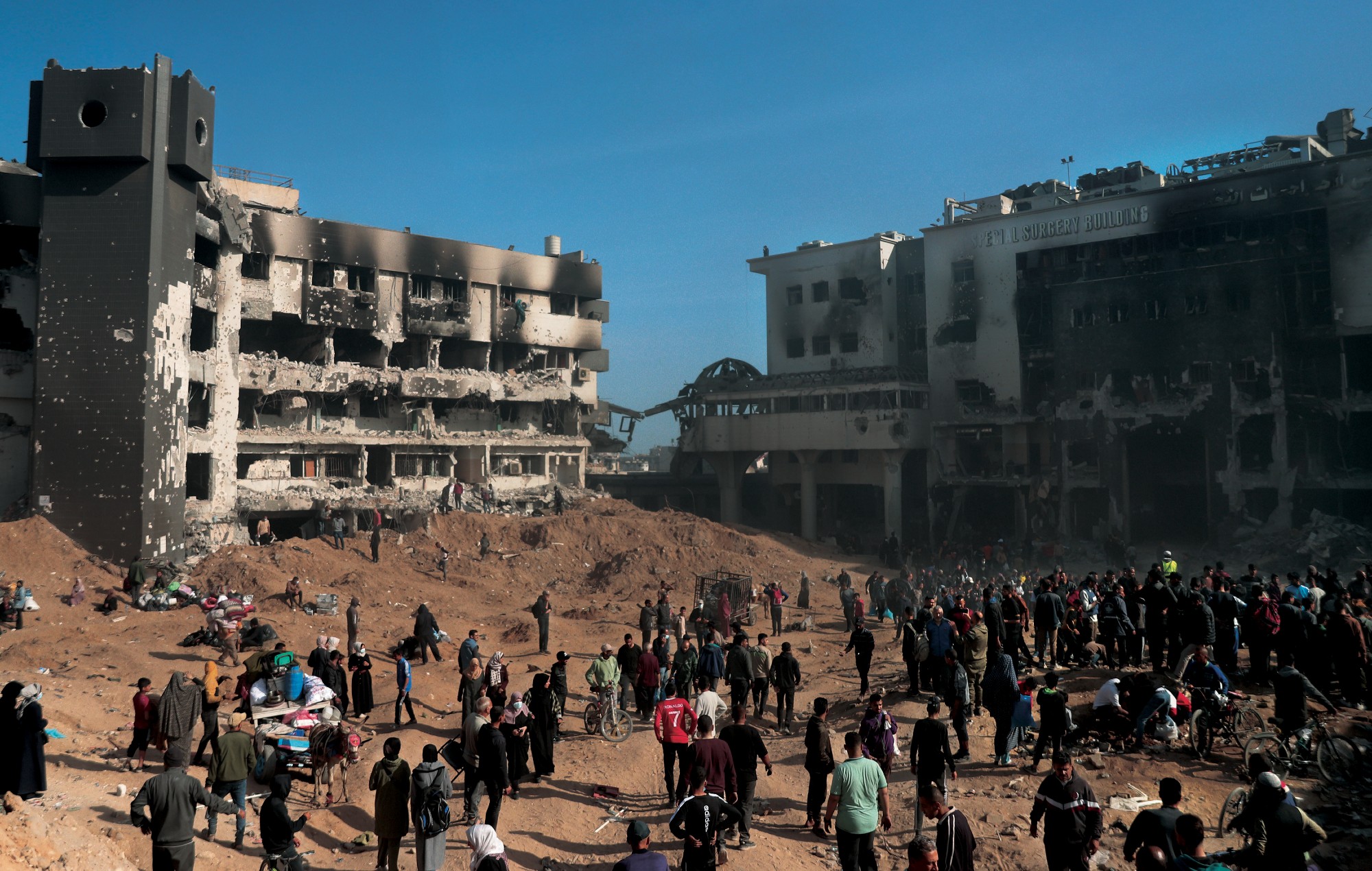
When foreign correspondents were barred from Gaza by the Israeli government, local doctors and nurses took on the extra duty of witnessing history firsthand. Daniele Rugo's documentary Life Support chronicles a medical team working under siege across two years, capturing what the film's production team identifies as the daily reality of systemic genocide. Narrated by Denise Gough, the film premiered in British cinemas in June and is currently circulating online across Prime Video, Apple TV, Curzon, and YouTube.
The documentary now has a dedicated companion record put together by Robert Del Naja. Issued across digital platforms alongside a charity vinyl run, the thirteen track collection channels all sales from the physical release directly to Health Workers 4 Palestine. The grassroots organisation, headed by Palestinian organisers, campaigns for health rights, a free Palestine, and an end to the apartheid regime.
Del Naja anchors the tracklist under his 3D handle, supplying three solo pieces titled 'Explosives Of The Future', 'Perfect Victims', and 'House Of Healing'. He also turns in a 3D remix of Kneecap's 'Palestine', which features Fawzi. Palestinian composer Habib Shehada Hanna shares a significant portion of the running time, contributing three compositions titled 'Sleeping Is A Privilege', 'Missing', and 'Gaza Gaza'.
Elsewhere, the compilation pulls in an international group of artists who blur the borders between underground electronics, traditional instrumentation, and rock. The Five Techniques brings together Paul Weller, producer David Holmes, and vocalist Róisín El Cherif for a cut named 'Resistance In The Dark'. Electronic veteran Yasmine Hamdan delivers 'Thirteen Kilometres', while Egyptian group Massar Egbari contributes 'Ana Mawgoud'. The selection expands further with Somali artist Aar Maanta on 'Sahnuuni', Palestinian Jordanian outfit 47Soul offering 'Ya Kho', and a joint appearance from Siba and Monkyman titled 'Dounana'.
Writing music to accompany such harrowing material proved to be a sobering undertaking for Del Naja. The producer observed that matching the lived realities of both medical volunteers and Palestinian civilians required a careful balance, acknowledging devastation while honoring the endurance and character of the people involved. Rugo noted that the soundtrack serves the narrative by avoiding overbearing drama, allowing Denise Gough's voiceover and the documentary images to breathe while giving the scenes a sharp emotional resonance.
Direct action around this issue is familiar territory for Del Naja. Just last month, the musician was arrested for a second time outside the Labour Party Conference after demonstrating with a placard denouncing genocide and endorsing Palestine Action. Massive Attack instituted a cultural boycott against Israel back in 1999, spending the intervening decades voicing steady support for Palestinian liberation. Those beliefs have sometimes brought trouble on tour. During a live appearance this past summer, Del Naja and Grant Marshall took a Palestinian flag on stage, prompting Singaporean authorities to detain the entire touring crew and bar two crew members from entering the country again.
That commitment to direct advocacy connects Del Naja to several other artists featured on the release. Kneecap recently joined Macklemore on stage at the opening show of a run of three benefit dates, directing audiences to support organizations such as Medical Aid for Palestinians, the Palestine Children's Relief Fund, Anera, UNRWA USA, and Jewish Voice for Peace. Both Kneecap and Massive Attack are also signatories to the No Music For Genocide campaign, standing alongside acts like Fontaines D.C. and Amyl and The Sniffers in using cultural pressure to call for justice.