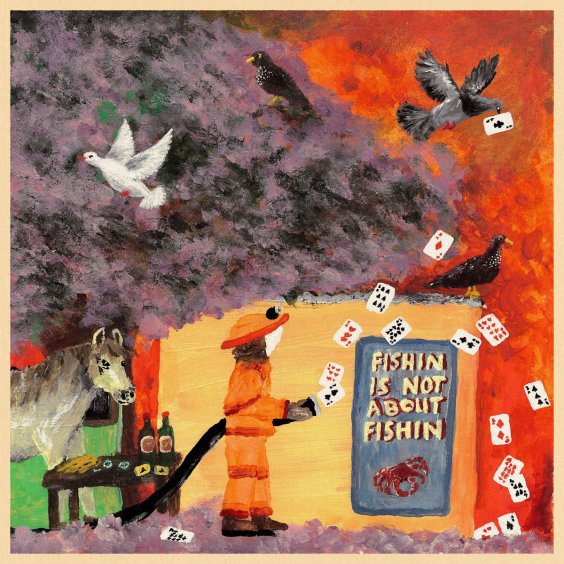
Ruby Gill has spent recent months building a body of work centered on direct, patient observation. The Melbourne songwriter is currently working toward a new collection titled Fishing is not about fishing, and her latest single, "Jamie," keeps that steady momentum moving. Arriving after a run of text-heavy material, the track represents another deliberate step toward a project that treats small personal histories as worthy subjects in their own right.
Gill's path toward this record took an unconventional turn back in June, when she issued a full-length album of live poetry. While contemporary folk and spoken-word traditions frequently pull from the same well, stripping away instrumentation entirely is a demanding exercise. A live poetry stage leaves nowhere to hide, forcing a performer to lean on cadence, unadorned phrases, and comfortable pauses. Returning to melodic songwriting after that kind of performance invariably sharpens a writer's editorial instinct. When verses are built to stand upright without the assistance of chords or rhythm sections, the resulting songs tend to carry far less clutter.
That disciplined approach was clearly visible on Gill's August offering, "Carol / not carol." Written in collaboration with her wife, the song operated as a quiet, grounded portrait anchored in ordinary household reality. Rather than reaching for grand statements about devotion, Gill let tactile routines do the heavy lifting. She opened with casual observation, singing, "Carol likes the way the light looks / When it's heating up the dash." A few moments later, the lyric zeroed in on another domestic ritual: "Playing poker in the evenings / She says we could use the extra cash." By focusing on the temperature of a car interior and card games played to help with bills, the writing relied on tangible evidence of shared living.
With "Jamie" arriving next, Gill seems committed to using individual names as anchors for her writing. Titling songs after specific people provides an immediate center of gravity, allowing a songwriter to examine affection, distance, and subtle domestic tensions without having to broadcast broad thematic conclusions. The listener is invited to watch an interaction unfold rather than absorb an abstract lesson. Paired with a title as dryly self-aware as Fishing is not about fishing, these tracks suggest a collection preoccupied with what lies underneath our regular routines, exploring why people gather, wait, and tend to one another.
The line connecting June's live poetry, the domestic snapshot of "Carol / not carol," and now "Jamie" shows an artist taking her time with language. Gill is assembling a record where ordinary habits, sunlight on a dashboard, and the people sharing the room receive quiet, serious attention.