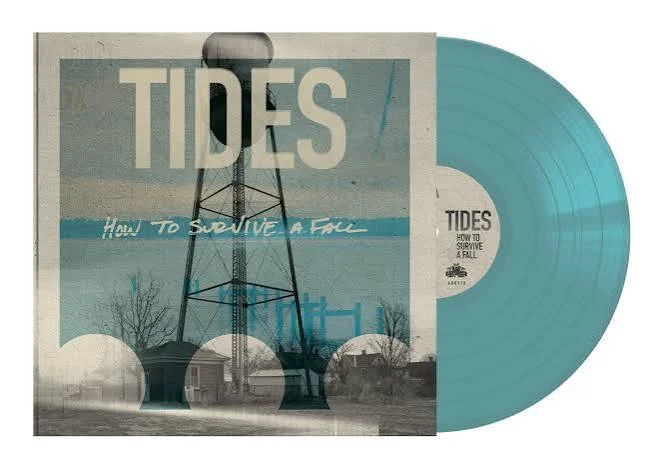
Jacksonville, Florida's TIDES have officially arrived with their first full-length album. How To Survive A Fall, released September 15 through A.D.D. Records in the United States and Little Rocket Records in Europe, turns the band's experience in the Northeast Florida punk scene into an 11-track statement built around urgency, melody and the physical energy of post-hardcore.
TIDES formed in 2023, bringing together musicians with years of experience playing in other bands across the local scene. Their first release was a split 12-inch with Golf War, but How To Survive A Fall represents a much larger step forward. Instead of introducing themselves through a short collection of songs, the band now has a complete record that establishes its sound and personality.
The album was recorded during the winter of 2025 after the group entered the studio with 13 songs. That material was eventually narrowed to 11 tracks, creating a record designed to work as a complete statement rather than simply a collection of individual singles.
The result is a compact album that understands the traditions of punk without treating them as limitations. TIDES draw from the melodic urgency of post-hardcore while retaining the directness and rough edges associated with American punk. The songs are short, focused and built to move quickly, but there is enough variation in the arrangements to keep the album from becoming predictable.
The record opens with its title track, “How To Survive A Fall,” before moving into “Collapse” and “My Own.” Those early songs establish the basic character of the album: guitars that carry considerable weight without overwhelming the vocals, a rhythm section that keeps the music moving and a sense of tension that rarely disappears completely.
“Undertow” offers one of the album's clearest examples of that balance. The song has the aggression expected from a post-hardcore band, but its melodic structure gives it a stronger emotional pull. Rather than relying entirely on speed or volume, TIDES allow the melody to create much of the song's impact.
That combination is central to the band's identity. There is a difference between making music that is simply loud and making music that uses volume as part of its emotional language. TIDES are interested in the latter. Their songs can feel urgent without becoming chaotic, giving the record a sense of control underneath its raw surface.
The middle of the album continues that approach. “Dave,” “Seconds To Last” and “All This Time” move between different shades of punk and post-hardcore while keeping the record's momentum intact. None of the songs overstays its welcome, and the relatively short running times reinforce the band's preference for direct songwriting.
“Calculated Loss” and “Dead Leaves On Main Street” push the album toward a darker emotional territory. The titles alone suggest a record concerned with uncertainty, disappointment and the consequences of decisions, but TIDES do not turn those ideas into overly dramatic statements.
Instead, the songs retain the conversational quality that has long been important to independent punk. There is a sense that the band is writing from experience rather than trying to manufacture a larger-than-life image.
That quality makes How To Survive A Fall feel connected to the community from which TIDES emerged. Jacksonville has a long history of independent punk and hardcore music, and the band has already shared stages with established acts including Alkaline Trio, Hot Water Music, The Subhumans, The Iron Roses and Tiltwheel.
Those live connections matter because TIDES clearly sound like a band that understands the physical side of punk music. These are songs designed to work in a room full of people, where the distance between performer and audience is small and the energy of the crowd becomes part of the performance.
The production keeps that feeling intact. Paul Lapinski recorded and mixed the album, while the mastering was completed at the Blasting Room, a studio with deep connections to the history of punk and alternative music. The finished record sounds focused without removing the roughness that suits the material.
The final stretch of the album brings “Maybe” and “It Stops Here,” closing a record that never loses sight of its central purpose. TIDES are not trying to reinvent punk rock. They are taking familiar ingredients and making them feel personal to their own place, history and group of musicians.
That may ultimately be the album's greatest strength. How To Survive A Fall does not depend on novelty. Its appeal comes from conviction. The band understands the traditions it is working within and uses them to make songs that feel immediate rather than nostalgic.
For a debut, the record is also remarkably focused. There is no sense that TIDES are trying to demonstrate every possible side of themselves at once. Instead, they have established a clear foundation that can be developed on future releases.
How To Survive A Fall arrives as a record from a band that has already spent years learning how to play in the world it wants to inhabit. The album may be TIDES' first full-length, but it does not sound like a band starting from zero.
It sounds like a band finally putting everything it has learned into one place.