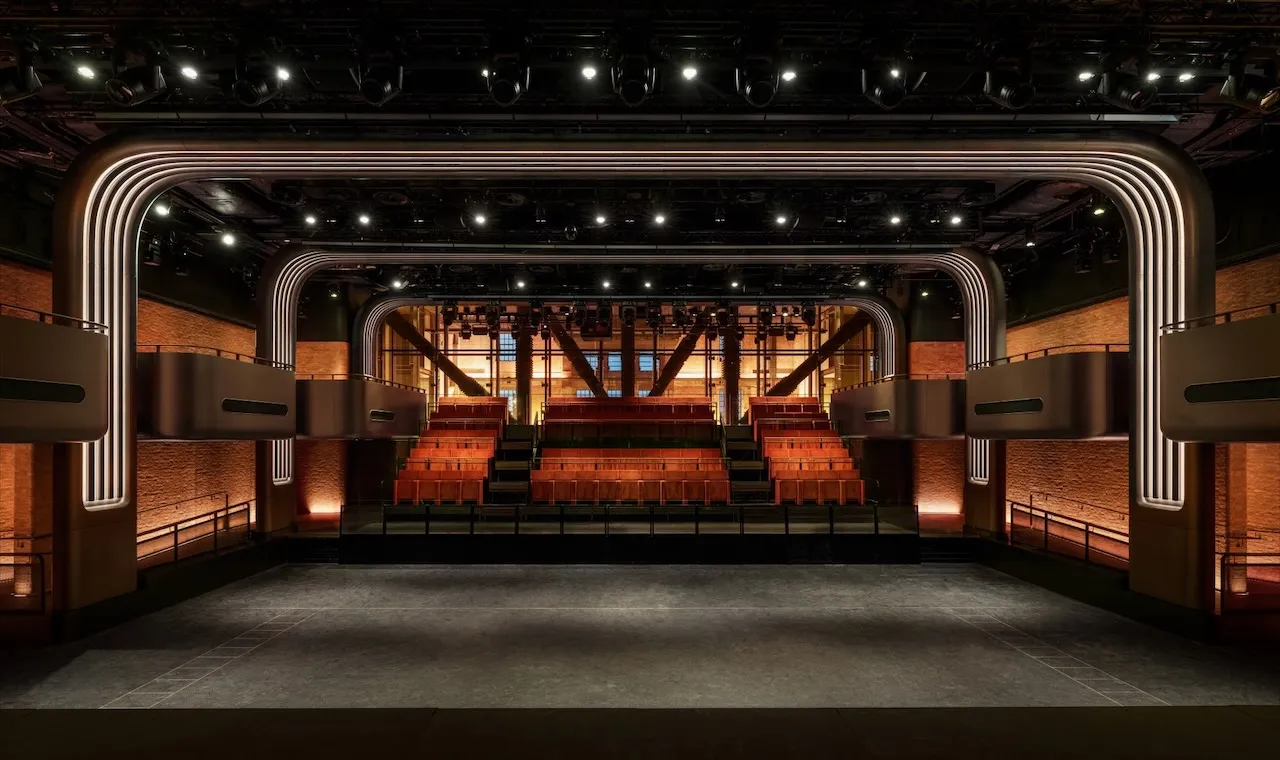
Standard live rooms tend to follow an identical blueprint. You get an elevated platform at one end, left and right speaker hangs flanking the proscenium, and a sound desk staked out somewhere across the center of the floor. Apple Music is diverging from that familiar pattern for its newest venture. Inside London's Battersea Power Station, the streaming service has mapped out Apple Music Hall, bringing its digital platform into brick and mortar sound.
The choice of room scale says a great deal about the project. By setting the capacity ceiling at 600 people, the project deliberately avoids the footprint of theaters or mid-sized touring stops. In an intimate room of this scale, an audience stays close to the action. Sightlines remain direct, energy gathers quickly, and listeners avoid the strange detachment that often comes with watching a set in an oversized commercial hall. The small square footage makes it clear that high-volume ticket sales are not the priority here. Instead, the focus settles entirely on staging controlled, finely calibrated shows.
The technical layout of the room diverges even further from normal touring circuits. Rather than pushing sound outward in standard left and right stereo channels, the hall relies on a 48-speaker Spatial Audio setup distributed across the interior. In an ordinary venue, the audio arrives straight from the front, hitting the crowd in a single forward push. Distributing dozens of individual speaker units across the walls and ceiling allows engineers to position and move elements of the mix three-dimensionally around listeners. That turns the physical room into an immersive playback chamber, effectively translating multichannel formats originally meant for headphones into an acoustic space shared by hundreds of listeners at once.
Behind the stage, the building is laid out as an active production facility. Most bands trying to document a performance with genuine fidelity have to rely on compromise. They rent a mobile recording truck to park on the street outside, or they string temporary lines into cramped dressing rooms, leaving the final balance to be rescued later during post-production. At Apple Music Hall, purpose-built recording and mixing suites are integrated directly into the property. That allows engineers to track and mix a performance with the clinical precision of a studio date while an audience is standing right in front of the monitors.
The same built-in thinking shapes the visual side of the room. The space incorporates integrated multi-camera broadcast systems that can film full sets for release down the line. In traditional historical rooms, bringing in film crews usually means assembling scaffolding, running messy power lines, and setting up large camera cranes that ruin sightlines for everyone holding a ticket. Designing those camera systems straight into the venue's core structure removes those visual obstacles. The hall is structured so that a concert doubles automatically as a permanent production document.
Placing this operation inside Battersea Power Station gives London a specialized facility where live performance and studio capture run concurrently. By pairing a small 600-person floor with broadcast gear, integrated mixing rooms, and a multichannel sound array, Apple Music has built something distinct from a standard tour stop. It is a live capture house designed from the ground up to turn an evening in a club into a finished record.