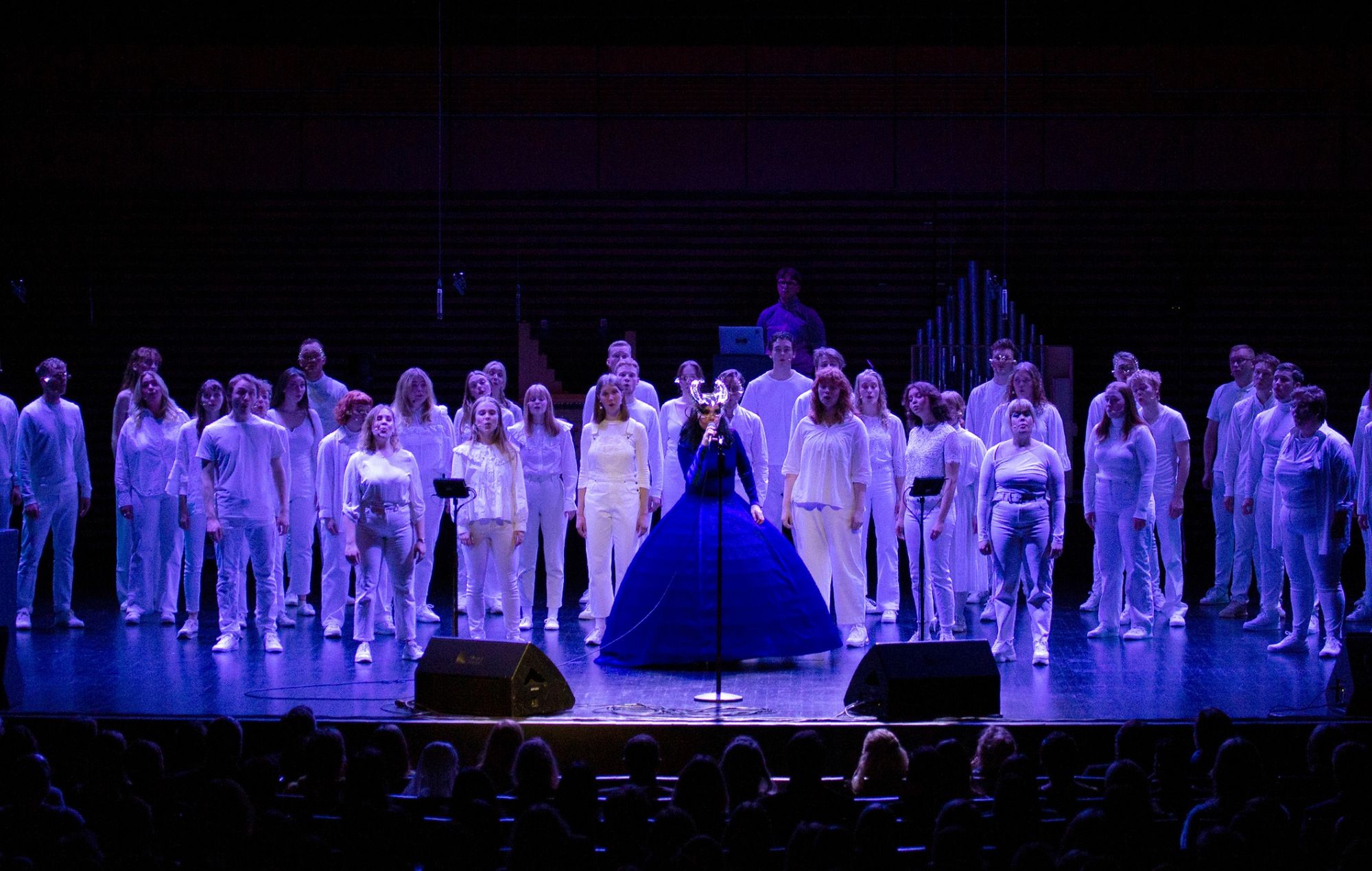
When Björk gathered with the Hamrahlíð Choir at Reykjavík's Harpa Concert Hall in the autumn of 2021, the staging was deliberately modest. Rather than leaning on the elaborate visual theater that often defines her touring productions, the performance placed full focus on acoustic sound, voices, and communal space. Five years on from that evening, the performance is receiving a physical release. Titled Björk Orkestral With The Hamrahlíð Choir, the full collection will be issued on November 27 across vinyl, CD, Blu-ray, and DVD.
The concert had a distinct local purpose from the outset, with its proceeds donated to Kvennaathvarfið, a women's shelter operating in Reykjavík. Musically, the night pulled heavily from Medúlla, her 2004 studio record that reconstructed songcraft almost entirely out of human vocal cord arrangements. At Harpa, those pieces were reconfigured with the help of strings, woodwinds, and the choir, setting up a balance between acoustic tradition, ensemble singing, technology, and natural textures. The Hamrahlíð Choir was already familiar with Björk's working methods, having contributed to the song Body Memory on her 2017 record Utopia. Bringing them to Harpa extended a partnership firmly embedded in Iceland's choral history.
Alongside the release announcement, a live recording of Where Is The Line has arrived as an advance preview. In discussing the track, Björk pointed to specific cultural roots that inform its strange shape. The twisting, unsettled melodic phrase she trades with the choir's bass vocalists was drawn from the intricate patterns carved into historical wooden bedposts on display at the National Museum of Iceland. The rhythm relies on changing time signatures, shifting across bars of five, four, and three beats, a metric quirk common in traditional Icelandic folk melodies.
Beneath the academic references, Björk also described the song as something of a stylistic joke. The arrangement collides the kinetic push of techno with the abrasive weight of death metal, all filtered through classical choral polyphony. That clash directly serves the lyric, which dissects the absurdity of preaching morals to somebody else when you are guilty of the same shortcomings. The chaotic friction between genres was meant to mimic that feeling of hypocritical tension, encouraged by the fact that the actual subject of her lyric was a devoted heavy metal listener.
The release of the Harpa concert lands in the middle of a remarkably diverse chapter of activity. During the summer, Björk played a rave DJ set scheduled during a solar eclipse, presented in tandem with her Echolalia exhibition at the National Gallery of Iceland. That gallery project featured three large audiovisual works, including reworked treatments of Ancestress and Sorrowful Soil, two elegies for her late mother that first surfaced on 2022's Fossora. The exhibition also introduced an unreleased composition called Nerve Bloom, which is earmarked for her next studio album in 2027.
Over the past year alone, her schedule has stretched across wildly different media. She teamed up with Rosalía at the 2026 BRIT Awards to deliver a live performance of Berghain, released a film document of her staging for the Cornucopia tour, and composed an original soundtrack for the multiplayer science fiction video game SEED. Yet for all her movement through international art spaces, pop ceremonies, and nightlife, Björk has consistently treated Iceland as her base. As she reflected in 2022, she appreciates city travel for gallery visits, concerts, and club culture, but she ultimately considers herself a rural person who requires the quiet rhythm of home to feel balanced. This document of the Harpa performance catches that instinct in full, returning her vocal ideas to the singers and concert halls where they first took root.