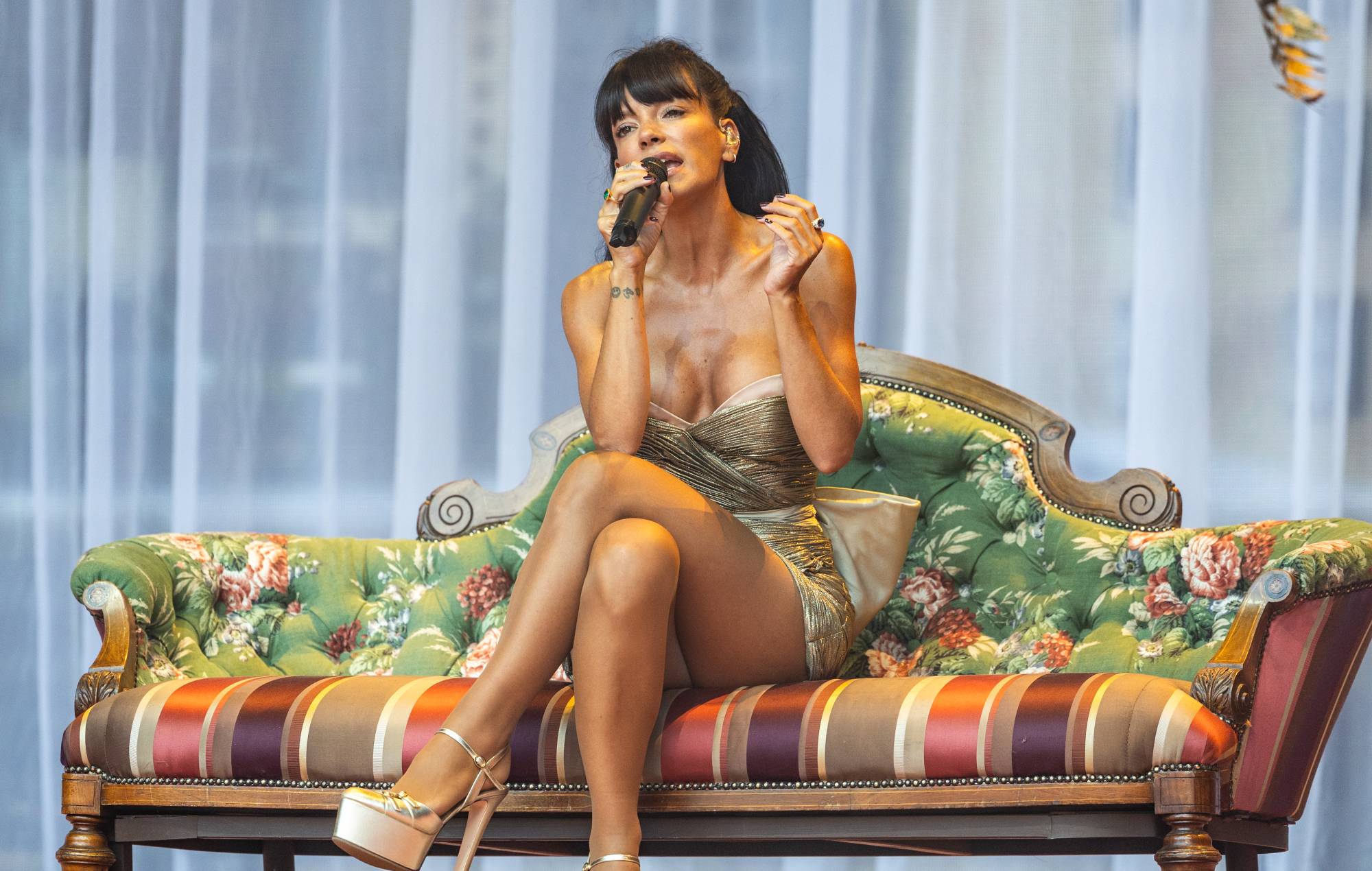
Standard procedure for an underperforming arena tour rarely involves public acknowledgement. When dates fail to shift tickets, artists typically blame sudden production delays or unresolvable scheduling issues, quietly sliding into smaller venues under cover of a polite press statement. Lily Allen went the other way entirely. Rather than skirting around the softer box office numbers from her recent North American run, she celebrated Halloween dressed as the very platform showing her empty seats.
Posting on Instagram on October 30, Allen unveiled a costume modeled directly on an unsold Ticketmaster arena map. Her getup consisted of a white puffer jacket and a matching bodysuit smothered in blue dots, topped off with a black shirt displaying the word Stage. Gripping a medical thermometer, she referenced blue dot fever in the caption, adding that she was never beating the allegations.
Across 2026, the term blue dot fever has become common slang among concertgoers tracking overambitious tours. Ticketmaster indicates every unsold seat with a bright blue icon, and when an arena struggles to draw, the seating screen turns into a wall of solid blue. It serves as an instant, unmistakable demonstration of the gulf between what promoters hoped to achieve and what audiences actually purchased.
The visual gag struck a chord because Allen had already weathered a very public restructuring of her North American dates. Back in July, she confirmed major cuts to the itinerary for her West End Girl tour. Planned stops in Los Angeles, San Francisco, and Chicago were downsized to significantly smaller spaces, while a date in Montreal was scrapped altogether. In Chicago, the show moved from the 23,500 seats of the United Center to the 3,500 seats of the Chicago Theatre. A scheduled stop at San Francisco's Chase Center ended up relocated across the bay to Oakland's Paramount Theatre.
Rather than hiding from the topic, Allen discussed the downsized run plainly in an interview last month. She acknowledged that the tickets had simply failed to sell and pointed toward overconfident industry forecasting. From the start, she had harbored doubts about the itinerary, asking her manager whether booking massive arenas was overly ambitious. Promoter reassurances swayed her team, and the schedule went forward despite her private misgivings.
Walking away from the dates entirely was not a step she wanted to take. Allen pointed out that she had a touring crew of around 50 people who counted on the run to earn a living. She also took aim at the general lack of clarity in modern concert ticketing, noting that she had seen fans pick up bargain tickets at the eleventh hour for dates she had been assured were completely full. She summarized the current state of live touring as a baffling minefield, remarking that while somebody surely understands how the machinery functions, the artist on stage is left in the dark.
The tour itself broke with standard pop conventions. Designed to showcase her 2025 release West End Girl, a record written after the end of her marriage to actor David Harbour, the show unfolded as a continuous narrative piece. Allen performed to backing tracks without a live band, maintaining a firm fourth wall and skipping traditional stage chatter with the crowd. While that choice disappointed some ticket holders who anticipated a conventional concert format, she stood by the setup, framing it as a focused storytelling exercise supported by a crew working relentlessly behind the scenes.
Turning up dressed as an unsold seating chart turned an awkward commercial setback into a joke on Allen's own terms. In a business where performers almost never admit when an arena has failed to fill, wearing the evidence out in the open feels far more sensible than pretending the empty seats were never there.