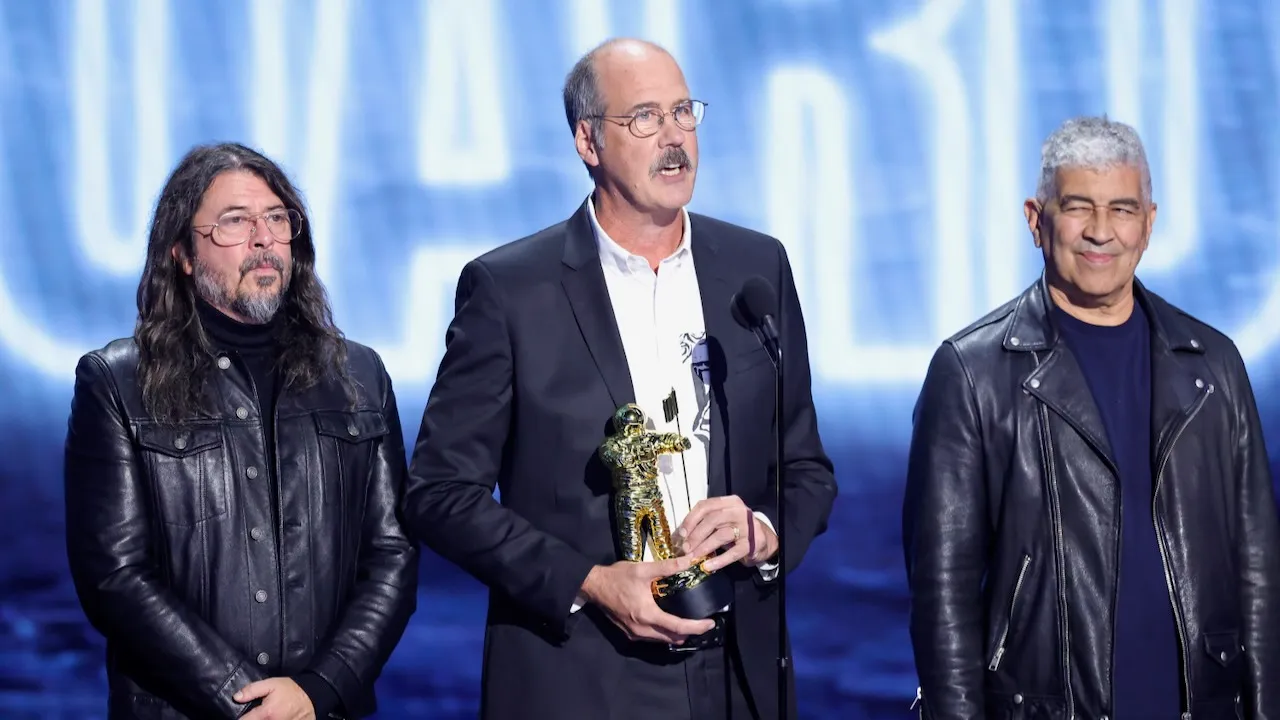
MTV typically shapes its Video Music Awards broadcast around the fastest-moving pop trends and the current chart cycle. When the network presents its Video Vanguard Award, however, the broadcast has to pause and reckon with sustained history. At the 2026 ceremony, that career distinction went to Nirvana. The moment brought surviving members Dave Grohl, Krist Novoselic, and Pat Smear together on stage, marking a body of work that continues to pull in new listeners decades after it first hit the airwaves.
The tone of the segment was established early when Public Enemy frontman Chuck D walked out to introduce the group. Pairing a cornerstone of hip-hop with Nirvana served as an effective reminder of an era when alternative rock and rap challenged the standards of television programming together. Both Nirvana and Public Enemy arrived without any interest in polished commercial templates, pushing urgent perspectives that disrupted ordinary music television and rewrote expectations for what belonged on screen.
Before Grohl, Novoselic, and Smear stepped up to accept the trophy, the broadcast rolled archival footage featuring the voice of the late Kurt Cobain. The video format was never merely an obligation or a standard promotional tool for Cobain, operating instead as a direct creative extension of his songwriting. Hearing Cobain speak in his own words gave the segment an emotional foundation, grounding the entire milestone in the singular perspective that drove the band.
When the surviving bandmates took the podium, Novoselic kept his reflections simple. Looking out at the audience, the bassist pinpointed authenticity as the core reason the catalog retains its power across generations. In an era where so much presentation is calculated, his comment cut straight to the point.
That perspective explains why the music remains such an enduring standard. Nirvana broke into mainstream culture at a time when heavy rock relied heavily on rehearsed excess, glossy production values, and exaggerated posturing. The band went in the opposite direction, favoring raw edges, direct expression, and visible vulnerability. The visual work that earned them the Vanguard honor matched that philosophy note for note, utilizing stark staging and flashes of surreal humor instead of manufactured glamour.
For an award show built largely on the commercial energy of the present, the sight of Grohl, Novoselic, and Smear standing alongside Cobain's archival presence offered a meaningful change of pace. The tribute honored a late bandmate while underlining a lesson that holds firm across styles, showing that unvarnished honesty on record and on film is what ultimately survives.