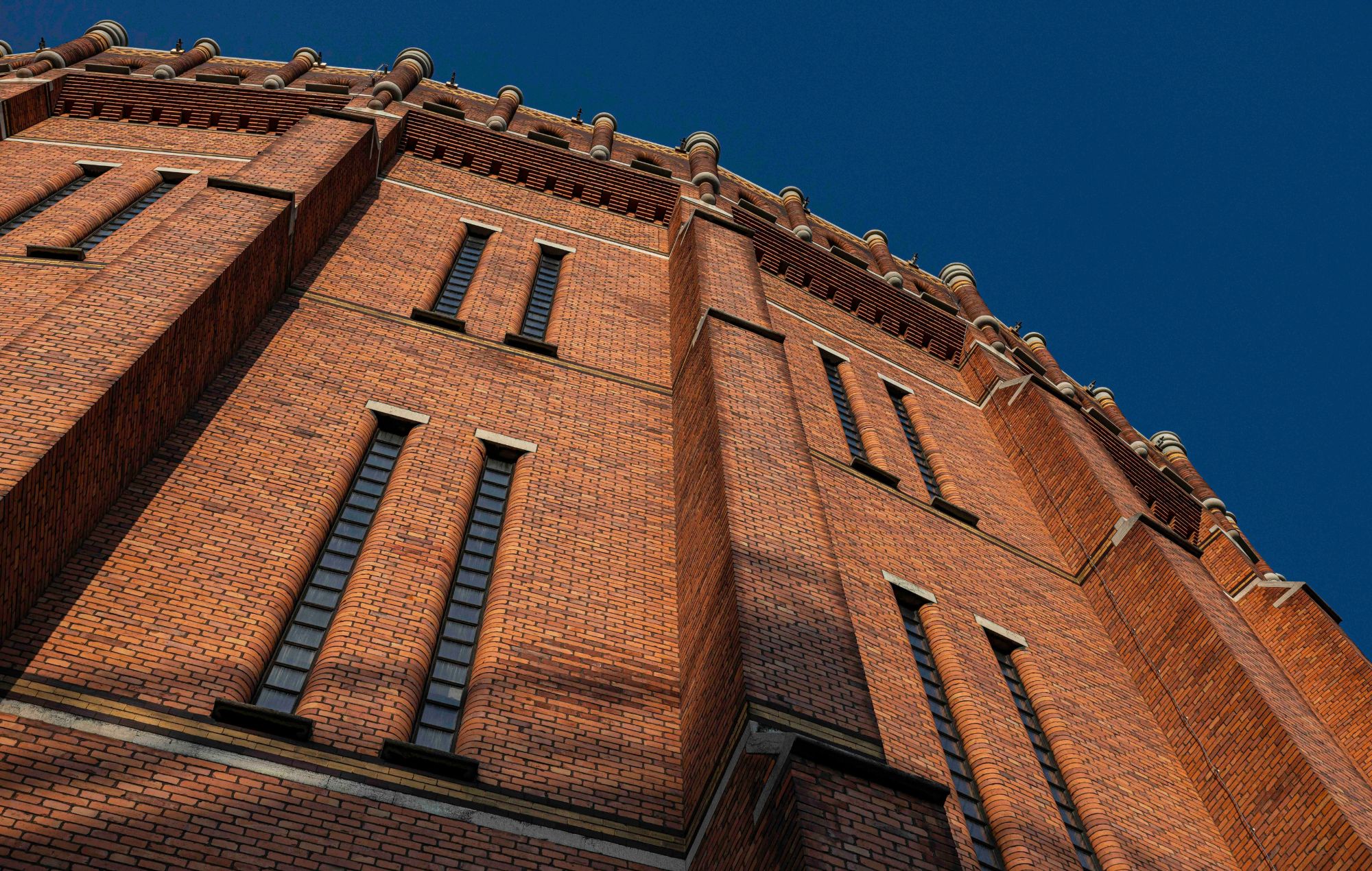
Converting decommissioned industrial utilities into concert halls is rarely straightforward, yet Stockholm is putting the finishing touches on one of its most unusual performance spaces to date. The venue is Gasometer, a newly developed entertainment complex housed inside a protected 1899 brick gasholder that opens on March 17 next year. Rather than treating its historic shell as a mere novelty, the project attempts to balance preserved structural history with up-to-date production gear, launching with a four-night run that highlights exactly what the building was designed to do.
The original circular brick structure was conceived by architect Ferdinand Boberg. Behind those century-old exterior walls, however, the interior has been completely rebuilt as a pillar-free theatre. The room is configured to accommodate 2,300 people for standing concerts, while seated setups can take 1,750. Tucked immediately beneath the roof sits another dedicated space, a 1,000-capacity room named the Dome. Together, these areas give the venue enough flexibility to transition between tightly focused recitals and large-scale productions without compromising line of sight or sound.
Hospitality and entertainment company Miramis is behind the venture, and they have placed Julien Planté in charge of programming. Planté arrives in Stockholm having previously worked at KOKO in London, bringing direct experience with the challenges of running contemporary shows inside a landmark historic theatre. His initial bookings demonstrate that Gasometer will not restrict itself to standard touring acts. In an arrangement that bridges high art and commercial touring, the Swedish Royal Opera has agreed to use the venue as its primary home base over the coming five years.
To open the complex, Planté has arranged a collaborative presentation running from March 17 through March 20 featuring composer Jacob Mühlrad and visual artist and creative director Alexander Wessely. The bill functions as a clear statement of intent for how the venue expects to operate. Mühlrad has spent recent years navigating comfortably between traditional orchestral spaces and mainstream contemporary music. Alongside commissions for Radio France and the BBC Proms, he composed the music for the 2025 Nobel Prize Banquet and has heard his compositions performed at the Royal Albert Hall and the Stockholm Concert Hall. At the same time, his credits include high-profile work with Swedish House Mafia and 070 Shake, reflecting an artistic range that reaches well beyond the standard expectations of a classical composer.
Wessely brings an equally demanding background to the staging. Working across design and creative direction, he has crafted visuals and stage environments for artists such as Rihanna, The Weeknd, FKA twigs, and Arca. His output has already been tested in several of the most technically complex live environments in the world, including Madison Square Garden, Coachella, and the Las Vegas Sphere. Putting Wessely and Mühlrad together gives Gasometer an opportunity to push its advanced audio and visual technology to its limits from the very first week, challenging both the acoustics of the hall and the visual possibilities of the interior.
Planté framed the inaugural pairing as a deliberate collision of artistic approaches. In his view, pairing Mühlrad with Wessely illustrates how the venue intends to link structural heritage with forward-looking artistic production. The goal is to provide a platform capable of handling complex staging while preserving the acoustic clarity needed for intricate musical arrangements.
Operating as both a temporary home for an opera company and a modern stop for touring artists requires an uncommon degree of architectural versatility. With its unobstructed main floor, separate Dome space, and high-end technical infrastructure wrapped inside Boberg's 1899 brick exterior, Gasometer is staking its reputation on being able to satisfy both worlds. When the doors finally open on March 17, Stockholm audiences will get their first look at whether this ambitious repurposing of an industrial landmark can deliver on its promises.