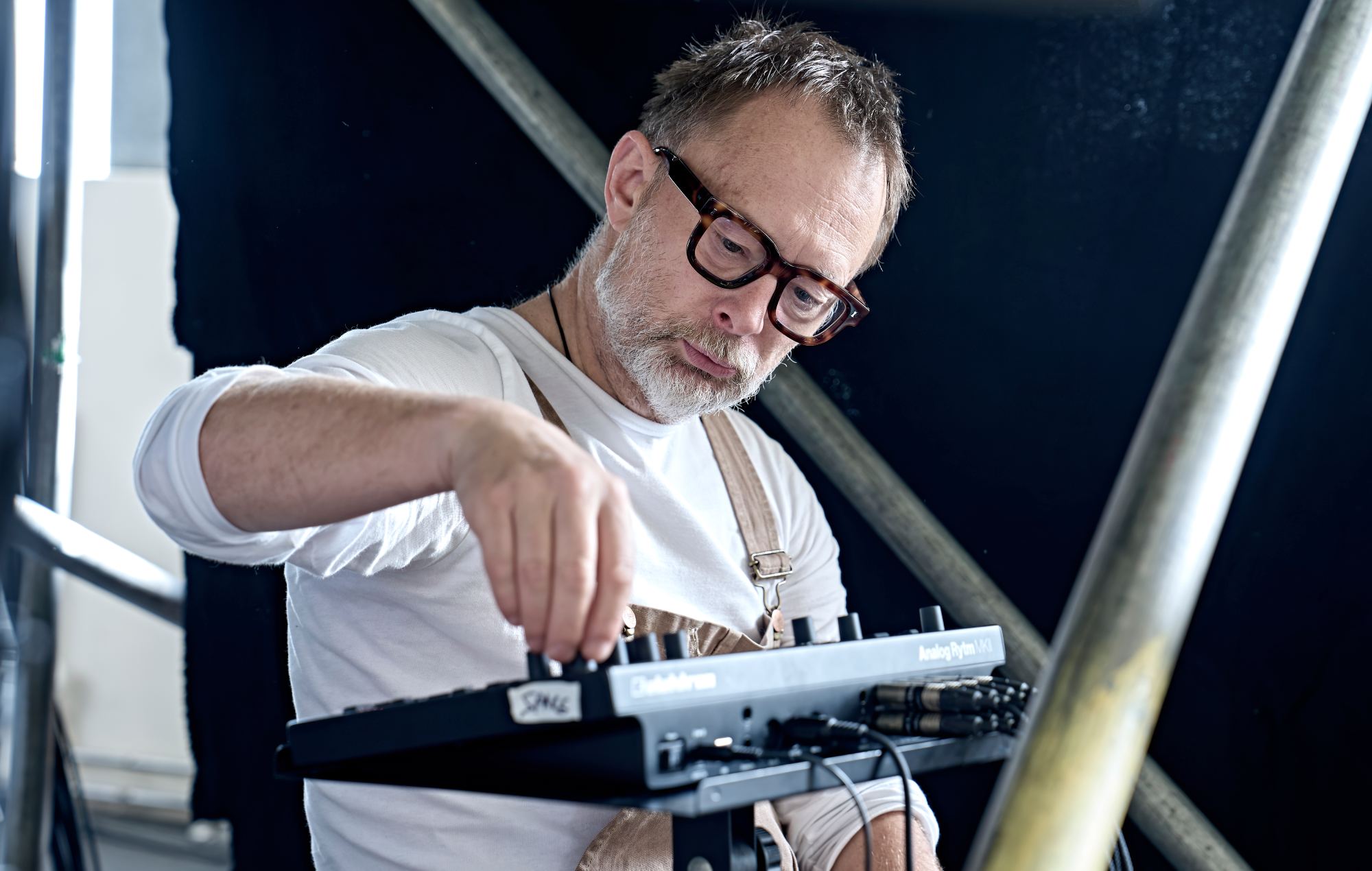
Manuel Harlan has been inside the rehearsal rooms for Hamlet Hail To The Thief, capturing the build toward the production's London arrival. The ambitious collaboration between Thom Yorke and the Royal Shakespeare Company takes over the Barbican Theatre this autumn, following its initial debut in Manchester. Directed by Steven Hoggett and Christine Jones, the project is an unusual collision, pulling Shakespeare's tragedy directly into the orbit of Radiohead's sixth album. Instead of leaning on the music as decorative mood setting or nostalgic accompaniment, the team is treating the 2003 studio LP as a working theatrical engine, built to carry the narrative from within.
The Barbican engagement is booked to open on October 31, 2026, running through January 23, 2027. What immediately distinguishes this staging is its sheer logistical ambition. Rather than hiding a band away in an orchestra pit or relying on prerecorded tapes, the production places more than twenty actors and musicians together on the stage. Yorke handled the orchestration and arrangement duties personally, reshaping Hail To The Thief specifically for this live troupe to play entirely in real time. Working alongside Hoggett and Jones, who both hold Tony and Olivier awards, the production blends physical movement, spoken drama, and live instrumentation into a singular, continuous performance.
In narrative terms, the production reimagines Elsinore as a claustrophobic surveillance apparatus. A frantic, unsettled energy governs daily existence inside Denmark, where citizens live under constant watch. Through this tense environment, Hamlet and Ophelia gradually peel back layers of systemic decay, corruption, and deceit. Their personal and political discoveries are not driven by standard theatrical beats, but are instead guided forward by music and spectral figures. The staging presents a community thoroughly infected by paranoia, ensuring that every key figure is swept toward an inevitable, ruinous end.
The connection between the play and the record was by no means obvious from the start. Yorke has stated that Shakespeare never entered the band's collective thoughts while they were writing and tracking the original material back in 2003. By his own admission, he usually maintains a healthy skepticism toward coincidental alignments, pointing to the familiar pop myth of syncing Pink Floyd's The Dark Side of the Moon with The Wizard of Oz. His earliest reaction was that Hamlet represented a sacred cultural text that ought to be left untouched. Even so, the underlying parallel kept surfacing, steadily moving from cautious skepticism into a full theatrical undertaking that reconsiders how these songs operate in dramatic space.
Working through that material has already caused ripples in the band's official archive. As Yorke revisited the songs to prepare for last year's Manchester run, the process led the rest of Radiohead to reconsider their sixth album as well. That period of reflection resulted in Hail to the Thief Live Recordings 2003 to 2009, an archival release compiling tour performances from London, Amsterdam, Buenos Aires, and Dublin. Those unvarnished stage recordings captured the songs at their leanest, offering a direct contrast to the layered orchestral reworkings now being rehearsed for London.
Mounting a hybrid production of this scale at the Barbican represents an intriguing test for modern rock composition. By weaving the music directly into Elsinore's political anxiety, Yorke, Hoggett, and Jones avoid treating the original songs as static artifacts. The upcoming London run will show whether that intense balance between classical text and live reimagining can hold its nerve over several months on stage.