Whenever an unsanctioned artwork appears overnight on a public street, it usually carries an unspoken understanding that its lifespan belongs entirely to luck, weather, or council clean-up crews. Matters get considerably more complicated when the artist is Banksy, the location is prime real estate in central London, and the local authority decides to safeguard the work rather than wash it away. Five months after the anonymous artist deposited a life-sized sculpture in Waterloo Place, Westminster City Council finds itself trapped in an expensive municipal holding pattern, trying to decide what to do with a piece of street art that has already cost tens of thousands of pounds to look after.
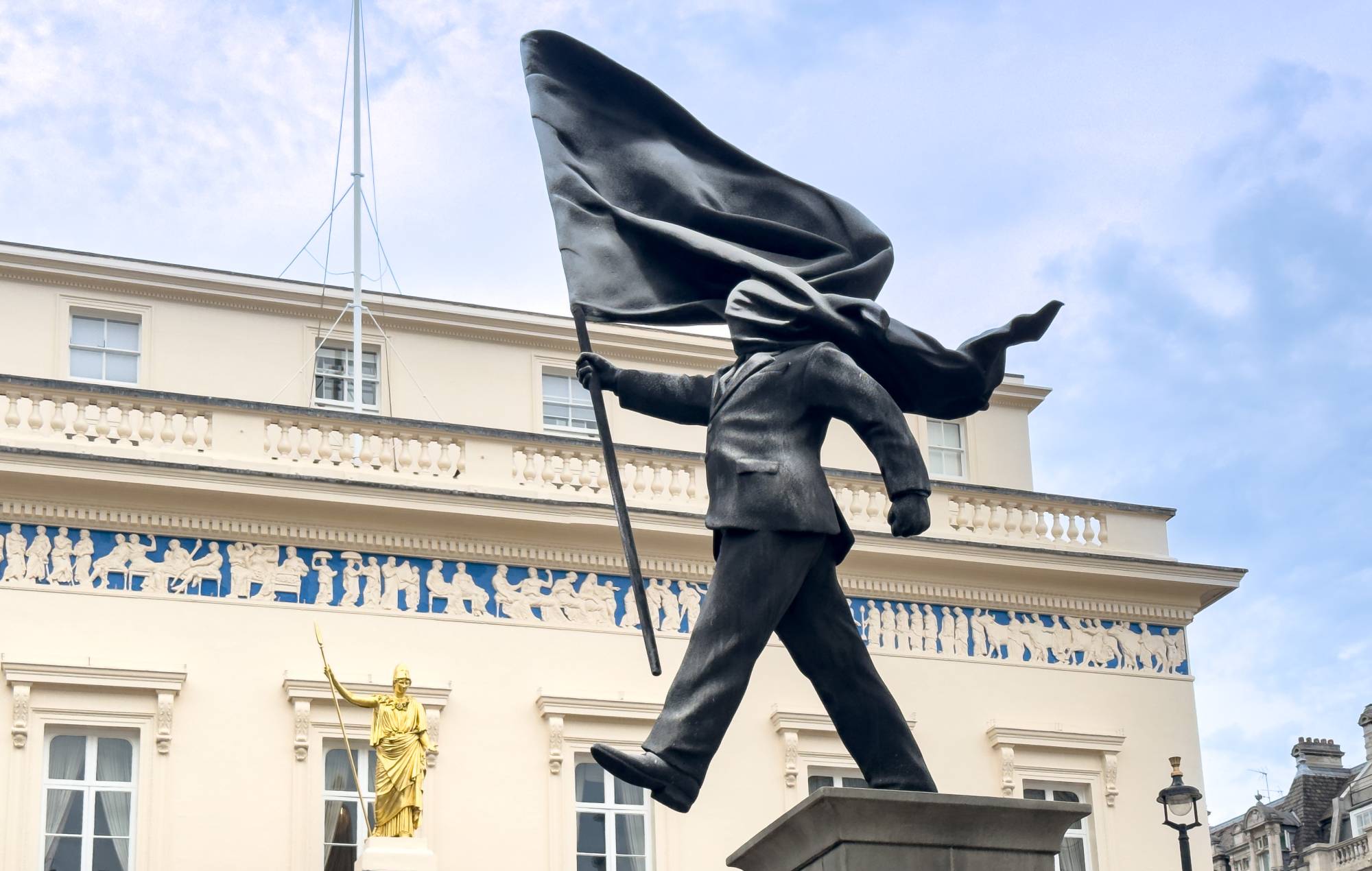
The work, commonly known as Blinded by the Flag, turned up before dawn on April 29. Positioned among historic monuments dedicated to Edward VII, Florence Nightingale, and the Crimean War, the installation features a bronze-coloured figure in a tailored suit marching forward off the edge of a plinth. The man has a broad flag wrapped tightly around his face and entire head, an image widely read by spectators as a commentary on blind national devotion. Although a signature had been left on the stone plinth, Banksy removed any ambiguity the following day by posting footage online documenting the overnight installation process.
At first, Westminster City Council took a welcoming stance. Officials celebrated the sculpture as a striking addition to the capital and assured visitors that it would stay accessible to the public. Half a year on, the practicalities of housing an uninvited piece on municipal ground have grown far more complicated. A council representative noted that staff spent the summer assessing every available route for the artwork, adding that no final decision has been established. The matter will go before an upcoming cabinet meeting for debate.
Behind the scenes, the arrangement has produced an unusual split in legal rights. A Freedom of Information release from August showed that Westminster asserted physical ownership over the sculpture on the basis that the council owns the land beneath it, while the artist retains copyright. Operating as an unexpected caretaker, the local authority has stayed in touch with Banksy's representatives while exploring short, medium, and long-term resolutions. That custody has come with a steep price tag. Public accounts indicate that Westminster has spent nearly sixty thousand pounds minding the statue, a total run up through administrative management, protective fencing, and the hiring of a dedicated security guard. Despite that paid surveillance, someone has managed to spray graffiti across the base, though the sculpted man remains largely untouched.
This ongoing council headache follows a familiar rhythm in the capital, where Banksy's political pieces consistently force awkward municipal choices. In September 2025, a stencil surfaced close to the Royal Courts of Justice showing a protester collapsed beside a bloodstained placard while a judge brandished a gavel overhead. Widely understood as a statement on arrests tied to Palestine Action demonstrations, that work was erased quickly, though Belfast rap trio Kneecap publicly commended it for hitting the nail on the head.
A similar logistical scramble unfolded during Banksy's run of animal images across the city. Over several days, a mountain goat showed up on a wall in Richmond, monkeys hung from a bridge in Shoreditch, a wolf was stencilled onto a satellite dish in Peckham, pelicans appeared beside a chip shop in Walthamstow, and piranhas decorated a police box in the City of London. That series concluded at London Zoo, where staff removed a gate painting of a gorilla releasing animals so it could be preserved safely in storage. In Waterloo Place, Westminster is left holding the bill for an artwork that pokes at political obedience, spending public cash to guard a blindfolded man walking off a ledge while deciding whether he gets to keep standing there.