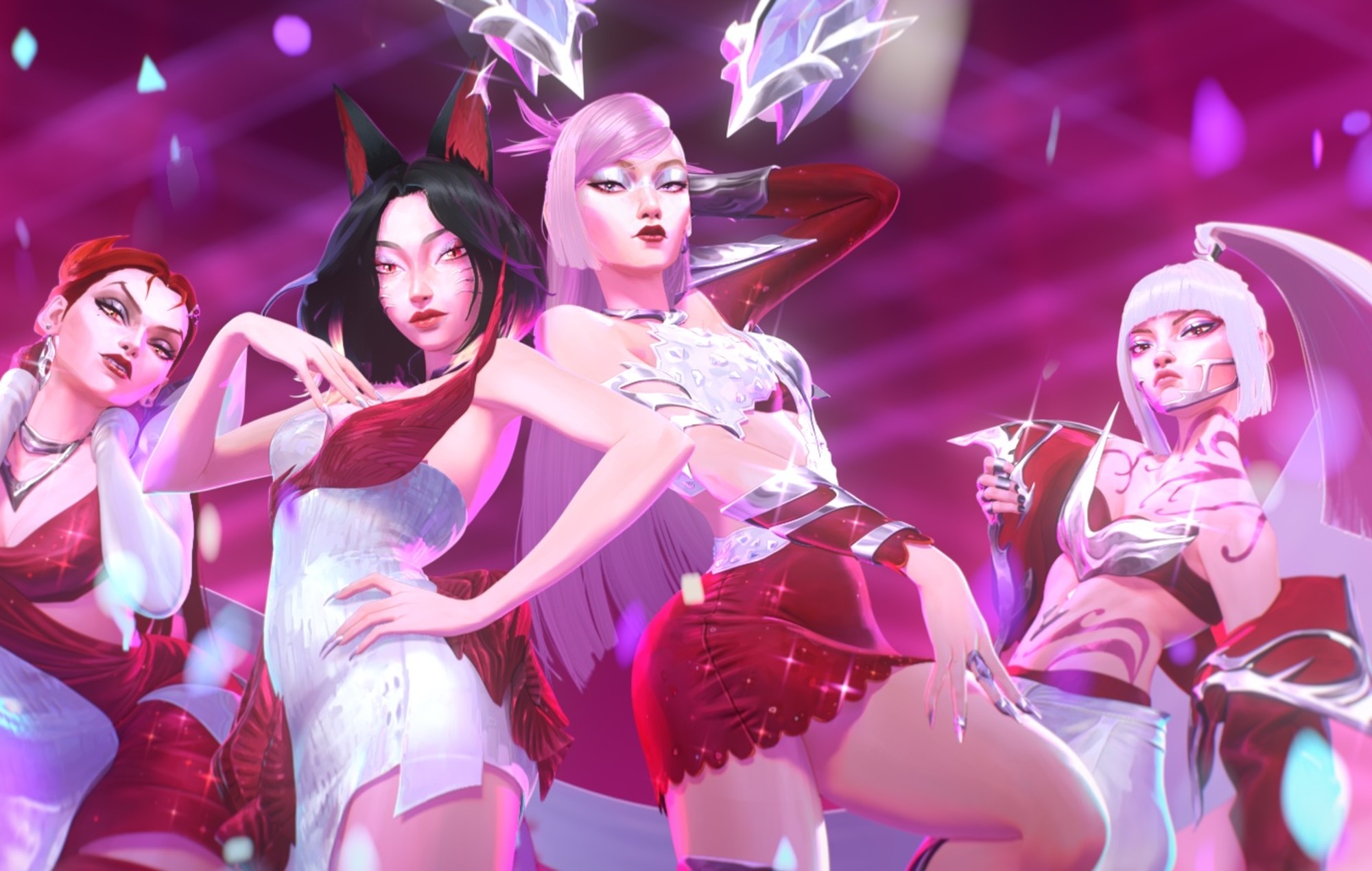
Six years after releasing their EP All Out, Riot Games has brought K/DA back into circulation. The virtual pop outfit originally surfaced in 2018 with Pop/Stars, translating League of Legends avatars into a functioning girl group with legitimate international reach. On Monday, October 19, the digital act issued a new track titled Firestarter. While the animated cast remains familiar on screen, the human roster singing behind two of the four champions has shifted substantially.
The most prominent absence is Madison Beer, who supplied the vocals for the assassin Evelynn during the earlier era of the project. Jaira Burns, who handled the voice of Kai'Sa, has also departed. Replacing them are Sophie Powers and Mimi Webb, with Powers stepping in as Evelynn and Webb taking over Kai'Sa. In a conventional pop band, replacing half the vocalists usually triggers an existential crisis or alienates long-term listeners. For a fictional ensemble, the dynamic is different. Much like legacy comic book characters or long-running animated franchises, the visual avatars remain the primary stars, allowing the studio to swap the people in the recording booth over time.
At the same time, Riot kept two vital pieces of the original formula intact. Miyeon and Soyeon, both from the South Korean act i-dle, return to voice Ahri and Akali. Their continued presence preserves the K-pop foundation that gave K/DA its identity from the start. Soyeon brings back her rap delivery, while Miyeon supplies the melodic hooks, giving Firestarter a recognizable spine that connects this current edition to the group's beginnings even as Powers and Webb establish their own vocal space.
The return arrives amid a wider musical push from Riot. Two weeks prior to the arrival of Firestarter, True Damage, another of the studio's in-house fictional groups, returned with a single titled Know My Name. That track pulled from New York drill styling and served as the official tournament anthem for the 2026 Worlds competition. Staggering releases from two separate virtual groups within fourteen days points to an intentional strategy, using distinct animated ensembles to experiment with varied corners of modern pop and hip-hop.
Alex Shahmiri, representing Riot Games, addressed the broader intent behind these digital ventures. According to Shahmiri, the main objective remains seeing how deeply music and gaming can intersect. He also brought up the running joke among fans that Riot is essentially a record label operating under the guise of a video game developer. Shahmiri acknowledged the heavy expectations tied to every release, conceding that the team will not always land every creative choice cleanly, but noted that substantial care goes into every project. He also suggested that the company has barely begun to explore the possibilities of its alternate musical roster.
With Firestarter, K/DA re-enters the field at a time when virtual groups are no longer treated as pure gimmicks. The updated lineup demonstrates that Riot views the project as a flexible, enduring property rather than a temporary stunt tied to a single studio session. Whether this particular configuration reaches the same heights as the 2018 debut remains an open question, but Riot clearly has no intention of abandoning its cartoon pop stars.