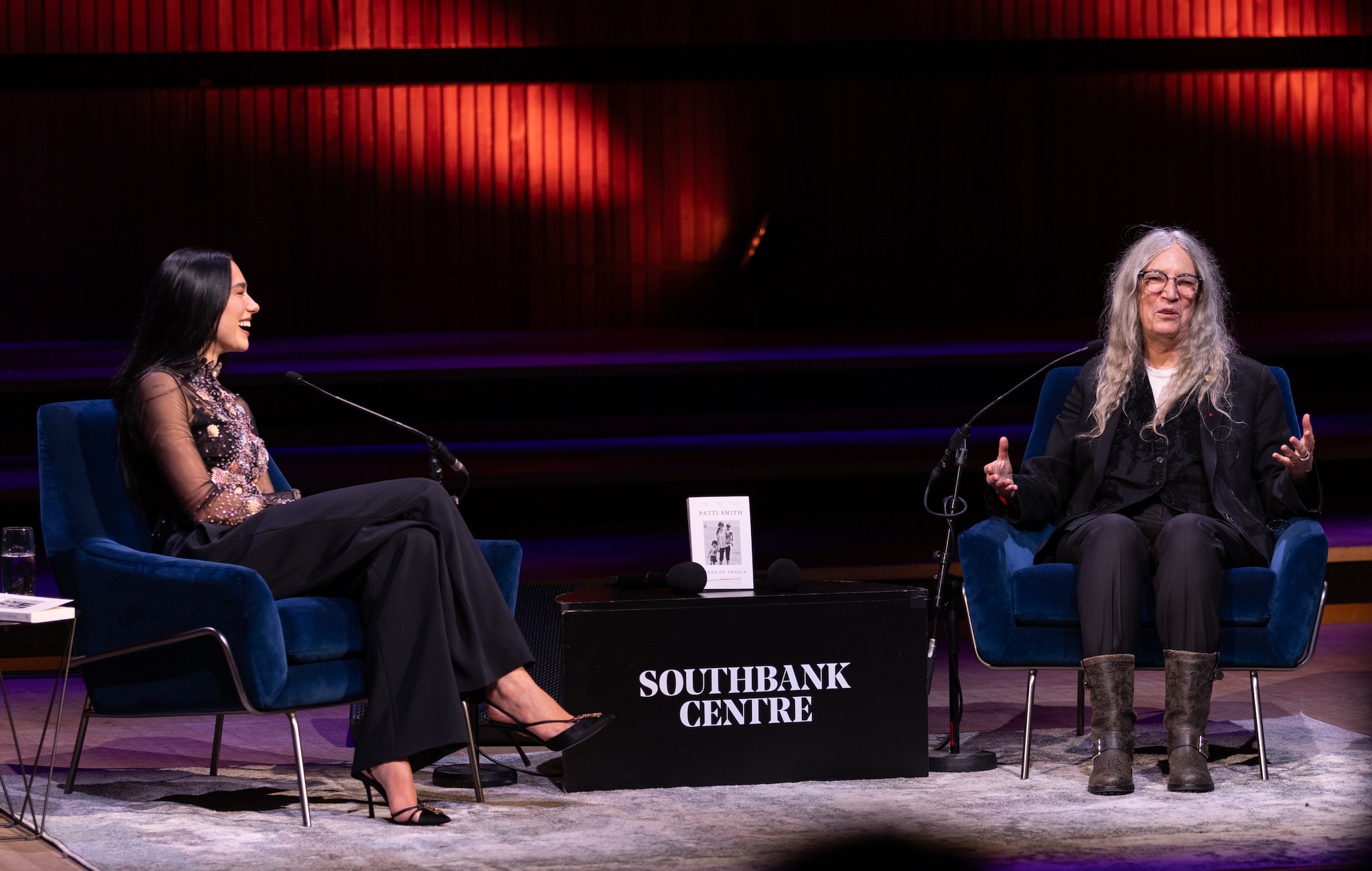
Patti Smith assumed she was finished with autobiographical writing after Just Kids. Carrying out a deathbed promise to photographer Robert Mapplethorpe took years of sustained labor from an artist whose instincts leaned naturally toward poetry and fiction rather than conventional personal narrative. Life writing, however, has a way of asserting its own demands. Taking the stage at London's Royal Festival Hall for the London Literature Festival, Smith joined Dua Lipa, who curated the evening as part of her Service95 Book Club, to unpack the ideas behind Bread Of Angels, her reflective memoir published last year.
Where Just Kids focused on a single defining partnership, this newer volume reaches back to Smith's childhood in Philadelphia and widens out across subsequent decades. In London, she framed the book as an intentional inventory of gratitude. Her aim was to study how a creative life is shaped not through solitary effort, but through a long succession of exchanges with parents, siblings, teachers, partners, mentors, and even the figures she resisted during her formative years. Identity, in her telling, is built out of collective wisdom and daily generosity.
The structural spine of the book arrived in an unconventional manner. After initially ruling out another memoir, Smith had a dream about an emissary carrying a plain white volume that plotted her path through four separate pieces of clothing. Those garments corresponded to real dresses given to her by people central to her life, including Mapplethorpe, her brother Todd, and her late husband, Fred Sonic Smith. Rather than treating the nocturnal vision as a clever stylistic trick, she took it as a direct instruction from the figures she loved, asking not to be left out of the narrative.
Finding a title involved a similar change of direction. Smith initially wanted to call the work Dancing Barefoot, borrowing the title of the track from her 1979 album Wave. Once she discovered that the name had already been used elsewhere, she returned to her manuscript to see what was already there. She picked out Bread Of Angels, an offhand phrase from her own pages that described those sudden, unpremeditated acts of kindness that tend to stay in the memory. Naming the volume after an unprompted gesture felt true to the spirit of the project.
Asked by Lipa where she sees that current of generosity in the present day, Smith pointed to a gathering in Spain that took place only days prior to their conversation. Three thousand choir singers had assembled to perform People Have The Power, the 1988 song she wrote alongside Fred Sonic Smith. Her late husband had conceived the track as an accessible tool for ordinary people seeking solidarity and strength, but he died before seeing the anthem take on that scale of communal resonance. Watching thousands of voices carry the song across an open gathering was, Smith noted, precisely the sort of collective spirit he had hoped to spark.
Smith also traced that acute sensitivity to the world around her back to her home life in Philadelphia. Her father made a habit of playing devil's advocate during family discussions, treating casual debates as exercises in curiosity and teaching her to question assumptions as a matter of course. That upbringing left her alert to quiet, functional kindnesses, from her bassist adjusting gear before a set to a stranger offering a nod on the street. In Smith's hands, memoir becomes less an exercise in self-portraiture than an ongoing effort to thank the people who made her work possible.